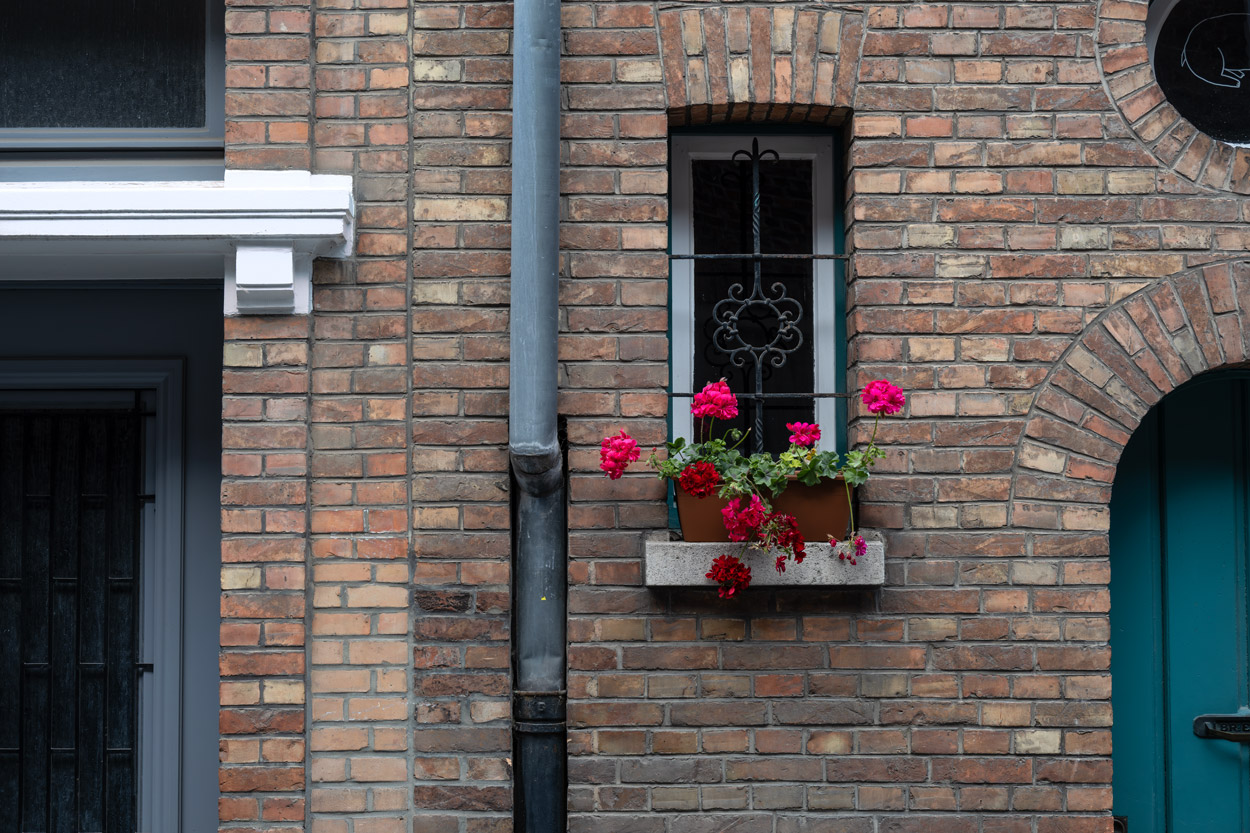
A Lonely Geranium, Bruges
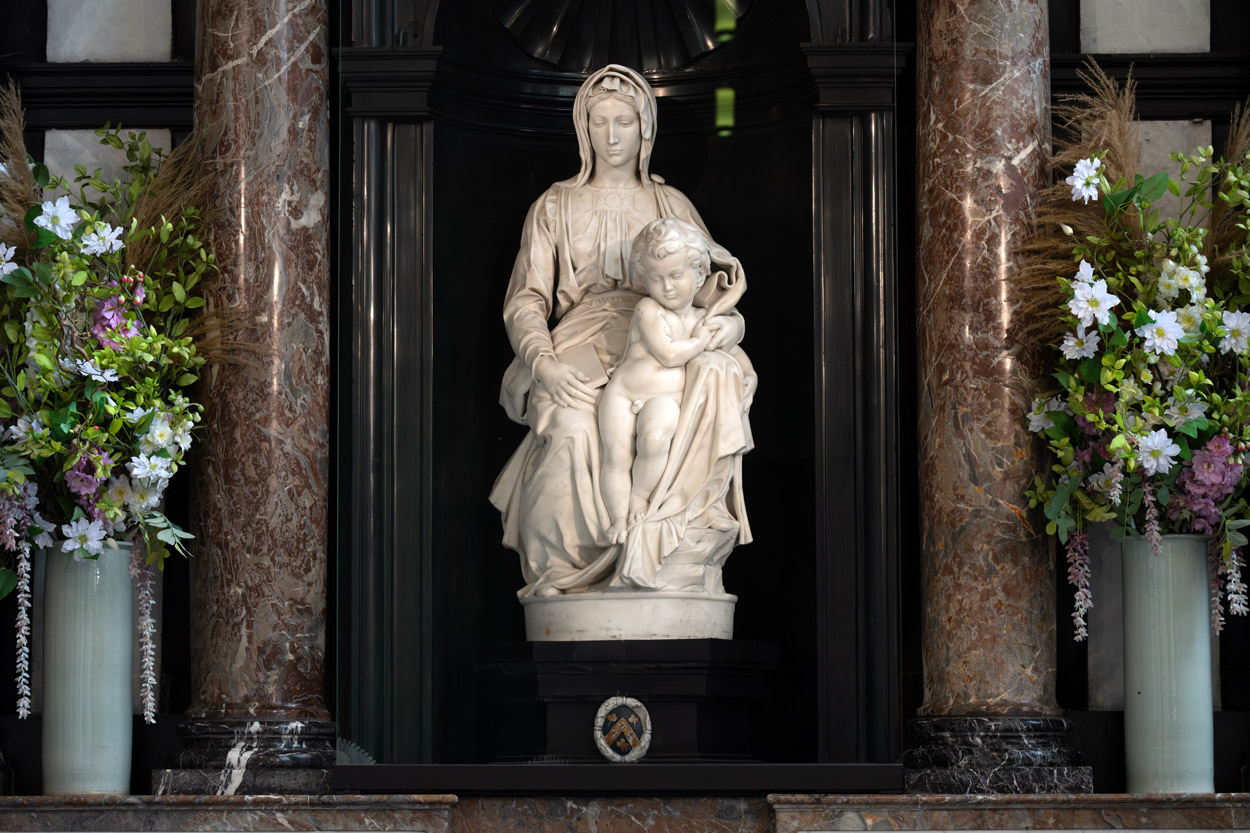
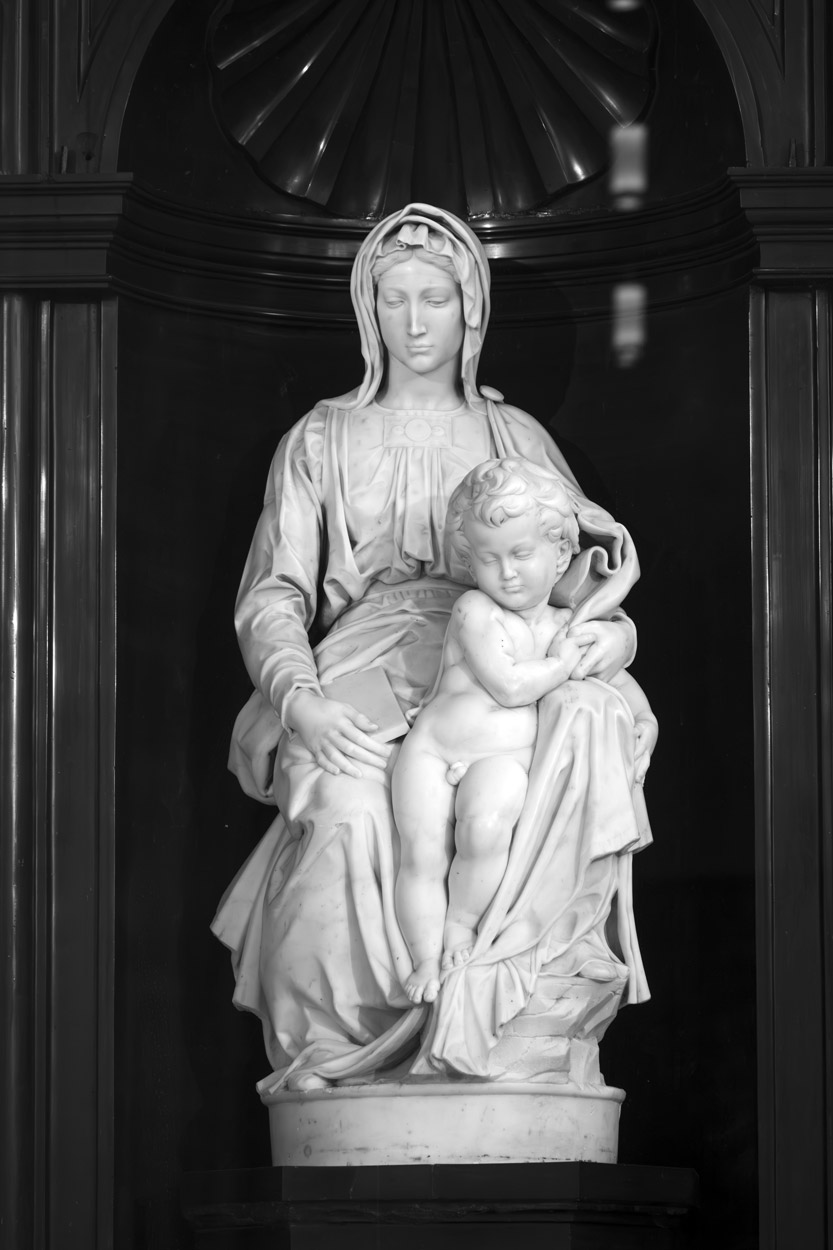
For me in any case, nothing better illustrates the historical prominence and wealth of Bruges than the magnificent Madonna and Child sculpture by Michelangelo on display in the Church of Our Lady. Wikipedia explains that the statue of Italian marble, completed in Italy in 1506, was destined for a location in Italy, but after a disagreement about money, Michelangelo sold the statue to the Mouscron brothers, two wealthy Bruges merchants. The Madonna was delivered to the buyers in Bruges and donated to its present home in 1514.
In fact Bruges played an oversized role in the revival of trade in Europe that began roughly in the 11th and 12th centuries. As European trade that had collapsed after the fall of the Western Roman Empire began to expand and flourish, Bruges for a time was northern Europe’s wealthiest leading city. In the third volume of his Civilization and Capitalism, 15th to 18th Century, French historian, Fernand Braudel, writes of Bruges:
It was all to culminate in the dazzling fortune of Bruges. By 1200, this city […] was included in the circuit of the Flemish fairs. This in itself made Bruges a more important place: she was receiving foreign merchants, her industry was thriving and her trade was reaching England and Scotland where she found the wool needed both for her looms and for re-export to the cloth-making towns of Flanders. […] And finally the arrival in Bruges of Hanseatic ships confirmed and developed her prosperity.
In 1277, the first Genoese ships put in to Bruges. The establishment of a
regular maritime link between the Mediterranean and the North Sea ushered in a decisive invasion by the southerners for the Genoese were but a foretaste of what was to come: the last of the newcomers, the Venetian galleys, arrived in 1314. […] But it was also a new departure [for Bruges] in the sense that the arrival of the sailors, ships and merchants of the Mediterranean brought in a wealth of goods, capital, and commercial and financial techniques. Rich Italian merchants came to live in the city, and brought with them consignments of some of the most precious commodities of the time: spices and pepper from the Levant which they exchanged for the industrial products of Flanders.
Thus Bruges came to be the centre of a huge trading area, covering no less than the Mediterranean, Portugal, France, England, the Rhineland, and the Hansa.
(Braudel, Fernand, tr. from the French by Siân Reynolds, Civilization and Capitalism 15th-18th Century, Volume III, The Perspective of the World, Harper & Row, New York, 1984, p99)
My interest in Europe’s medieval and early modern history, fueled by scholars like Braudel, got me to Bruges in the first place. I was curious and wanted to take a look. The fact that the old part of the city is a beautifully preserved, magnificent UNESCO World Heritage Site was unexpected and most welcome icing on the cake.
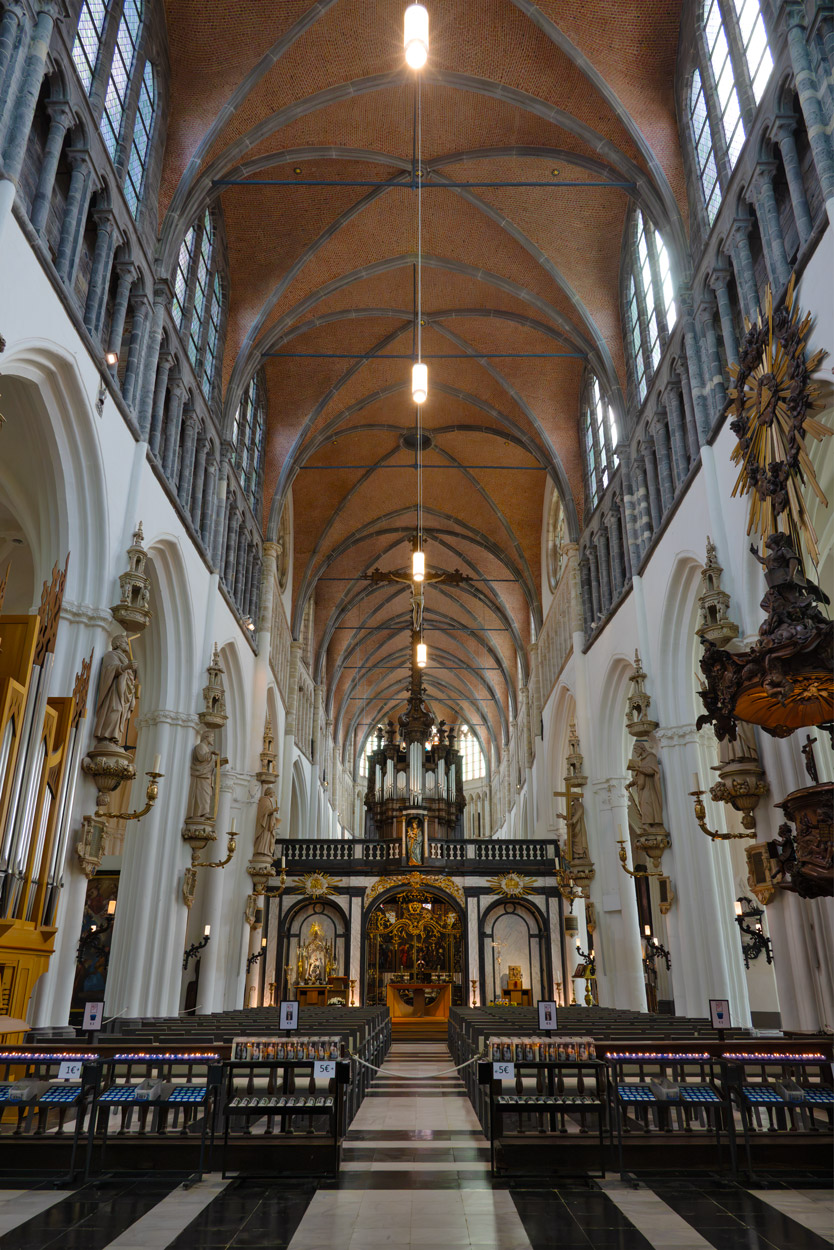
The sanctuary of the Church of Our Lady is open to the public for viewing, and like so many venerable European churches, it is impressive in and of itself. This church, however, has a part of its ground floor set aside as a museum that, if I am not mistaken, I paid €10 to enter. There was virtually nobody about when I walked around; I enjoyed an almost private viewing of the Michelangelo masterpiece. Given the crowds that often surround works by well-known artists, I was both surprised and grateful to have some quiet time in the presence of genius.
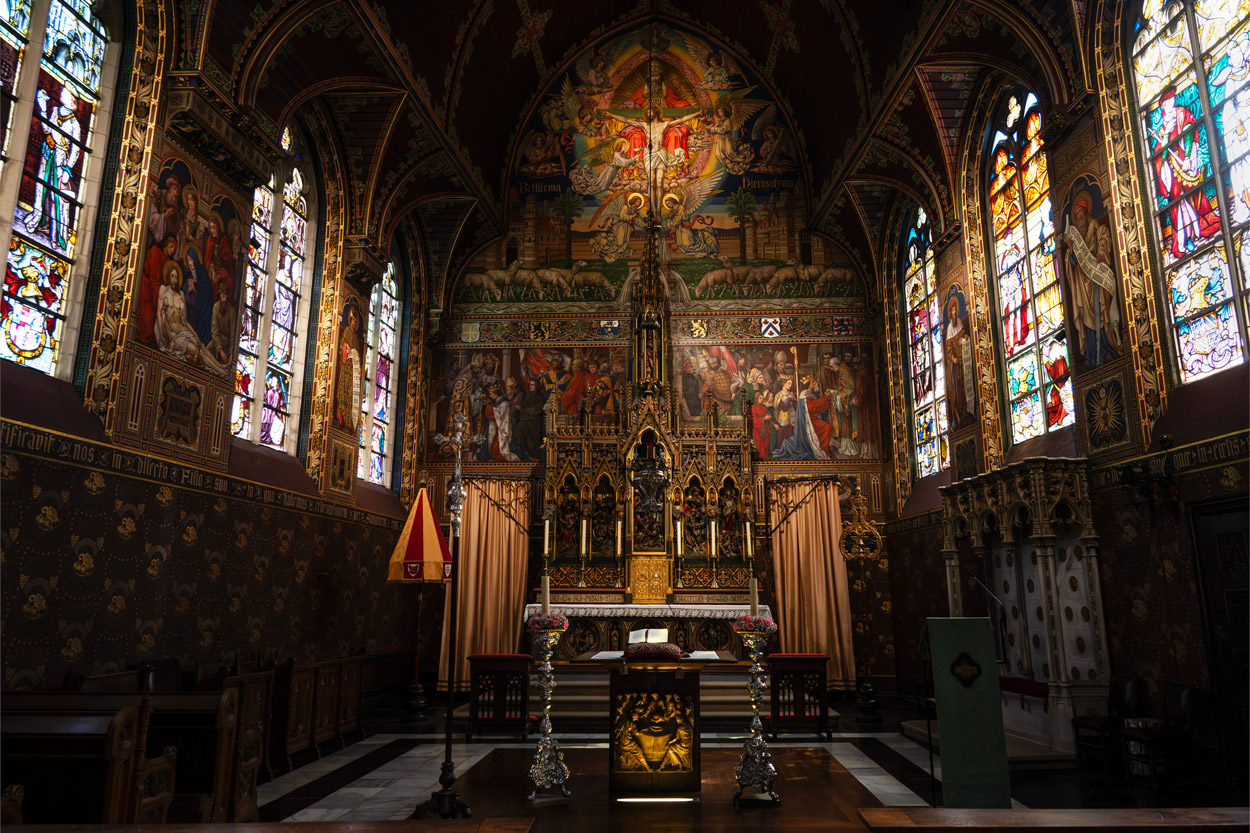
The exterior of the Basilica of the Holy Blood, next to Bruges City Hall in Burg Square, does not really look much like a church from the outside. There were people, obviously of the tourist persuasion, walking up a few stairs and through an entrance way; I was curious and followed them in. Inside, I saw a sign identifying the place at the foot of more stairs. I headed up and eventually walked into the remarkable main chapel, the Gothic style of which is somewhat unlike anything I have seen in the many churches I have visited over the years. Apparently, the church is home to a relic of the Holy Blood that a couple of bozos brought back from the Holy Land at some point. Make whatever you want of that. The church was built in the 12th century.
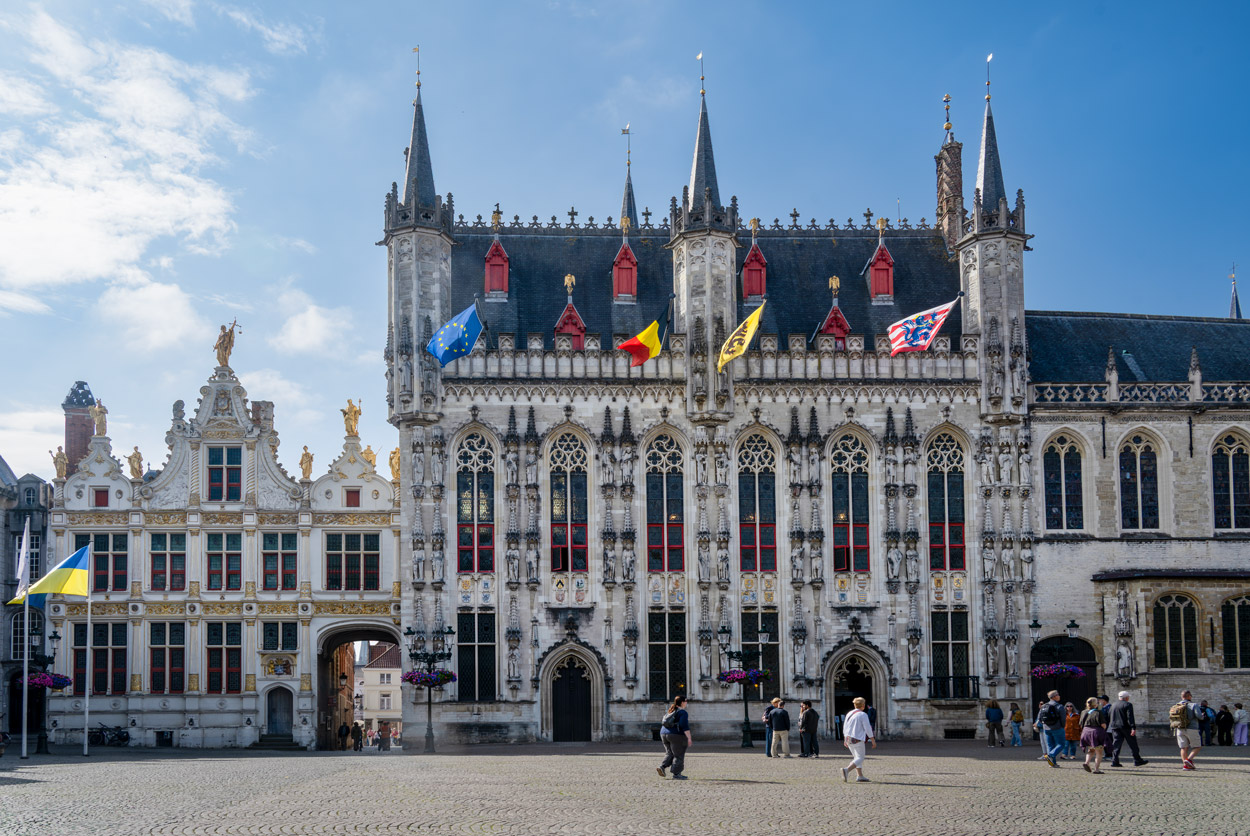
Construction of the Gothic style (or to be more precise – the late Gothic monumental style) Bruges City Hall was begun in 1376 and completed in 1421. The building is still the seat of the city government today. Parts of the interior are open to the public, but regrettably I did not make time to go inside. There is only so much one can see during a three day visit.
Adjacent to City Hall in Burg Square there are bistros for beleaguered bureaucrats in need of sustenance of the solid or liquid variety.
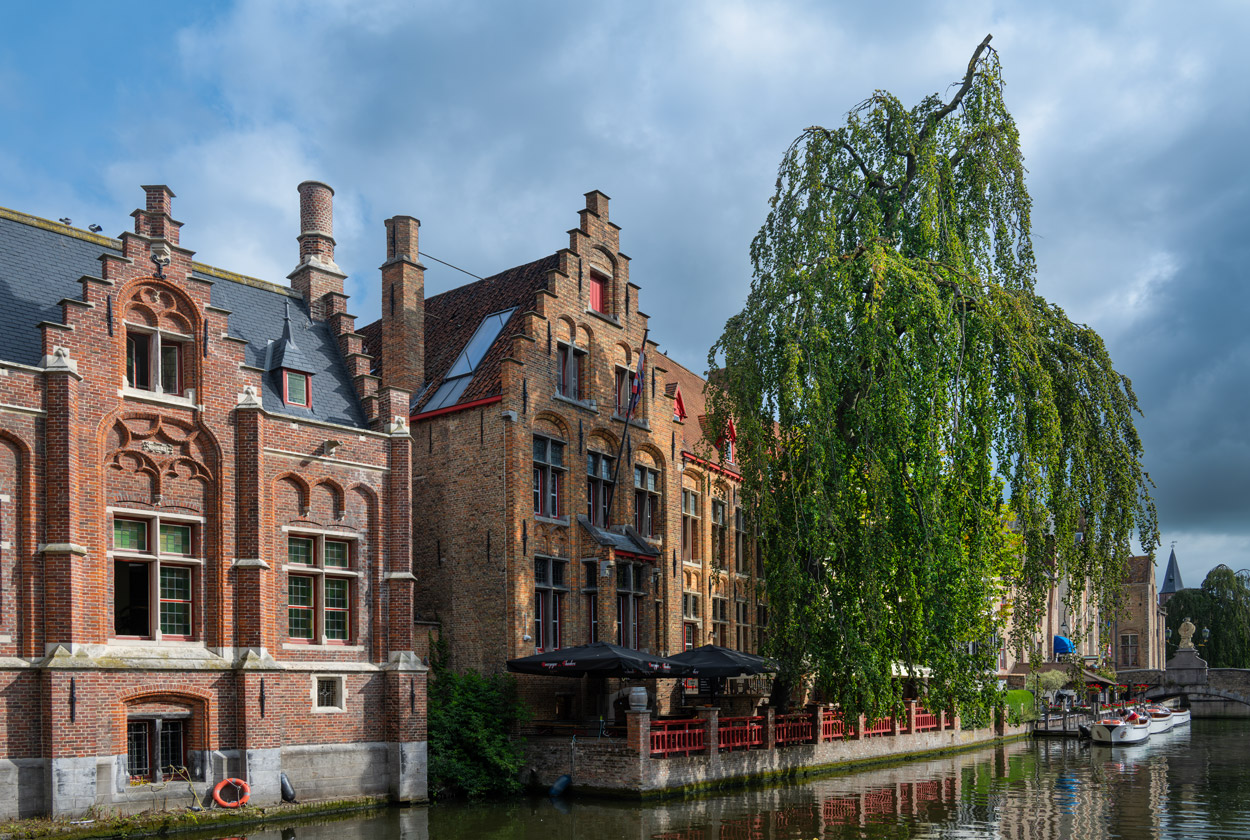
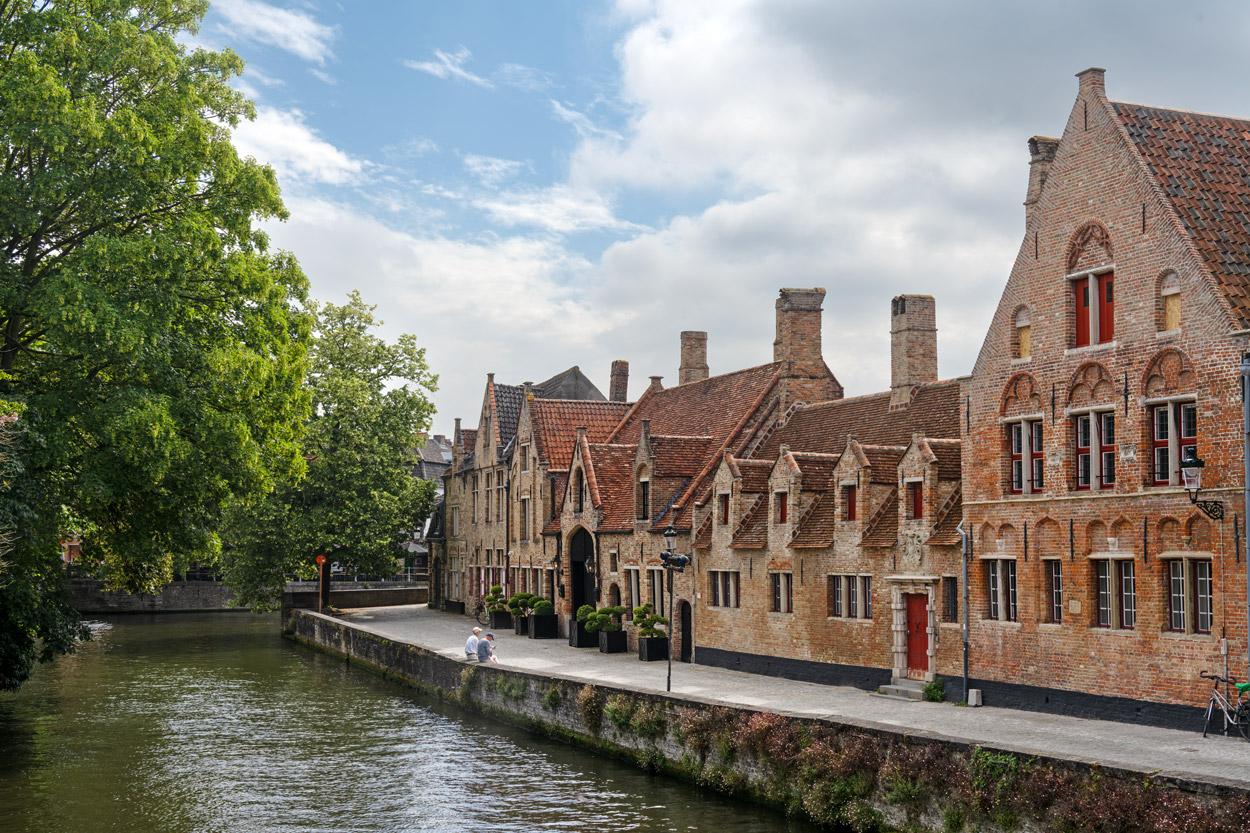
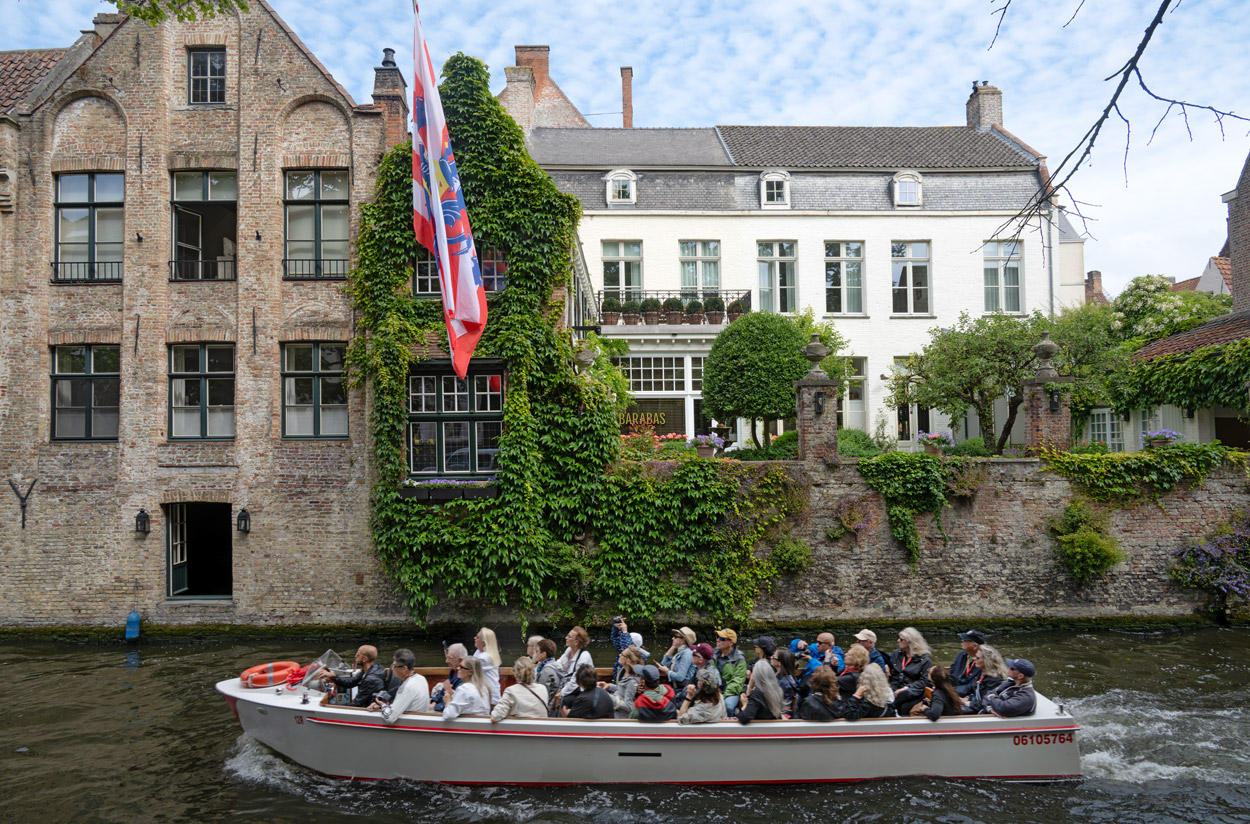
Like Venice and Amsterdam, Bruges has canals that link the old parts of the city together. What role these canals played in the history and development of Bruges, I cannot say. The only activity I saw on the canals were the sightseeing boats that took visitors on water-level tours of the city.

A significant number of the shops along Bruges streets frequented by tourists were selling pricey chocolate. Words like “handcrafted,” “homemade,” “gourmet” and others of the same ilk were paired up with “chocolate.”
Now I like fine chocolate, and to be honest, am even fonder of not so fine chocolate, the kind that has too much milk and sugar and does not tell us the percentage of cocoa in the mix. You know, because there isn’t all the much. I am not, however, obsessed with chocolate, be it cheap milk chocolate or fashionable dark chocolate. I like the stuff but going without chocolate does not result in withdrawals or anxiety attacks for me. My problem with chocolate is not addiction, but portion control. I may be indifferent to chocolate, but once I do start in on a chocolate bar or a box of bite-sized chocolates, I invariably eat way too much or many, as the case may be. Add some almonds or hazelnuts with or without raisins to the chocolate and portion control goes even further out the window. Because a few nuts lets me justify my chocolate binge by deluding myself the nuts have plenty of nutritious oils and other good stuff. I easily ignore the fact that eating a handful of almonds without the chocolate has all of that nutritious stuff without a lot of the empty calories that comes with a chocolate binge. Yeah, I’ve heard that foodie influencers talk up the health benefits of dark chocolate. Maybe they are right. Or maybe they are just making a virtue out of eating stuff they like. Or maybe they are getting paid to say it is good for us. Whatever, while I do like to eat, I pay little attention to foodies.
The number of places selling waffles seemed to run about neck and neck with the number of chocolate shops. One also could not walk far in Bruges without passing a window full of bottles showcasing dozens of varieties Belgian beer. In the event, I tried and enjoyed with meals several Belgian beers, all of which I had never heard of before. For better or worse, I did not once eat any waffles (a regrettable mistake on my part) or buy any chocolate (no regrets).
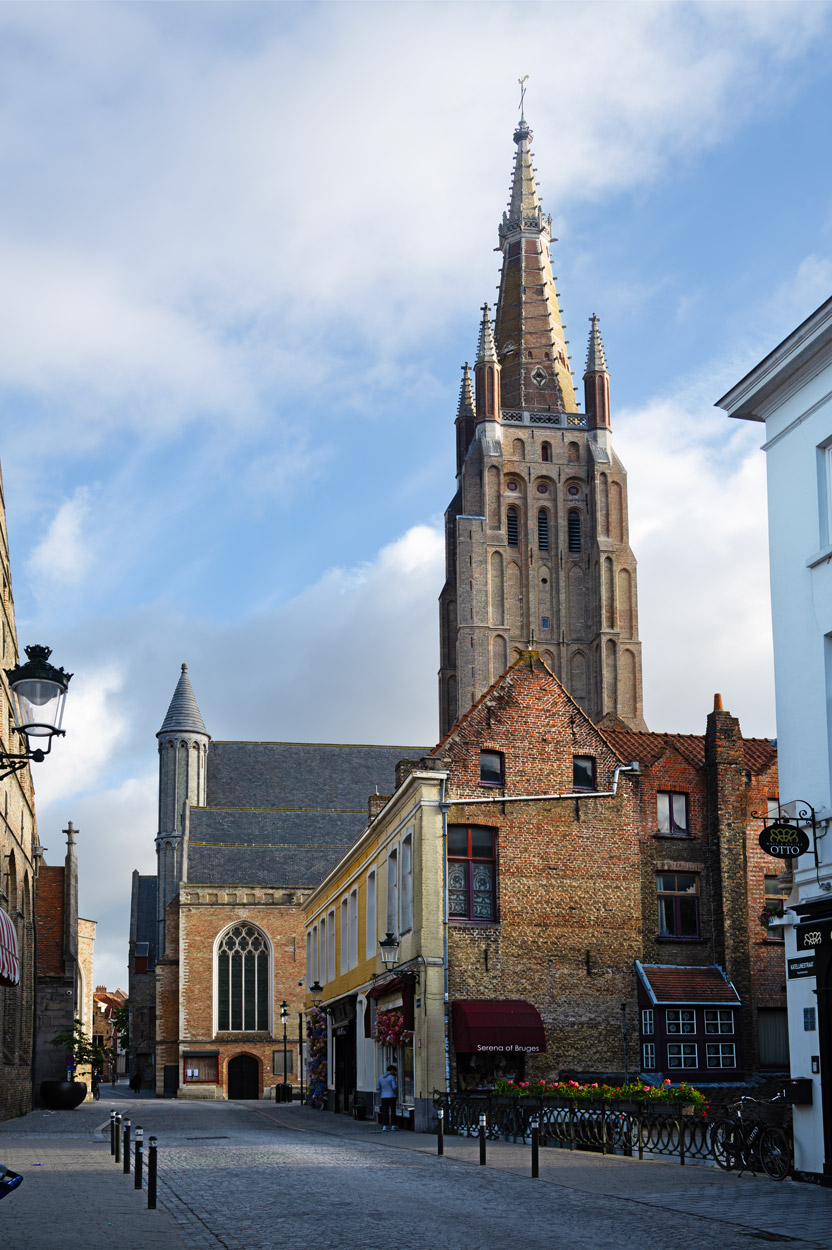
On my first morning in Bruges, I set off at just past 7:00 am to walk to the center of the old city. I soon came upon the enormous 115.6m high tower of the Roman Catholic Church of Our Lady. Construction of the Gothic church began in the 13th century and was completed in the 15th century. The brickwork tower is the second highest such structure in Europe (or the third, depending on which source one chooses to believe). Whether second or third, the massive tower dominates its surroundings.
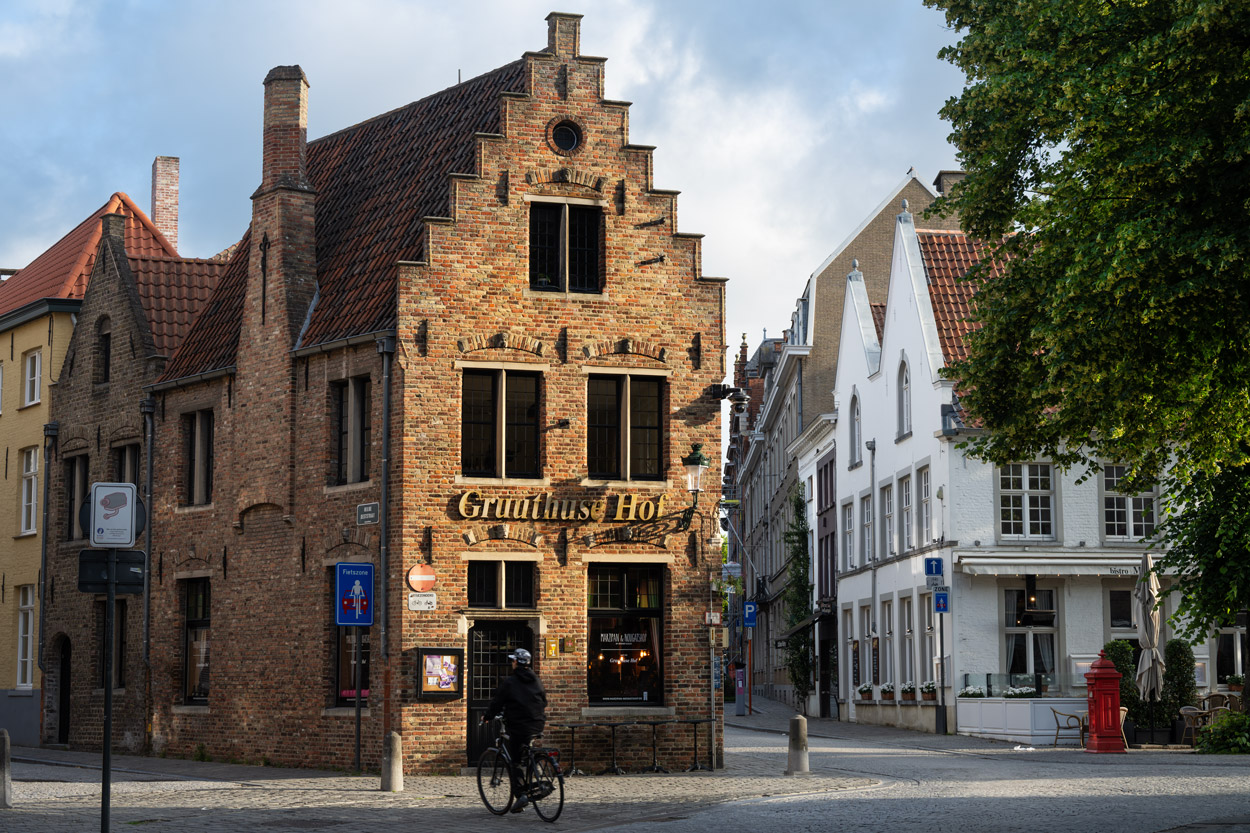
Bruges is a small Belgian city of about 120,000 people located on the North Sea in the northwest of the country near the Dutch border. The center of Bruges is part of a sizeable UNESCO World Heritage Site of some 430 hectares. My plan was to walk from my hotel near the southern end of the oval-shaped Site to the Markt or Market Square, about 1 kilometer away in the heart of historic old Bruges.
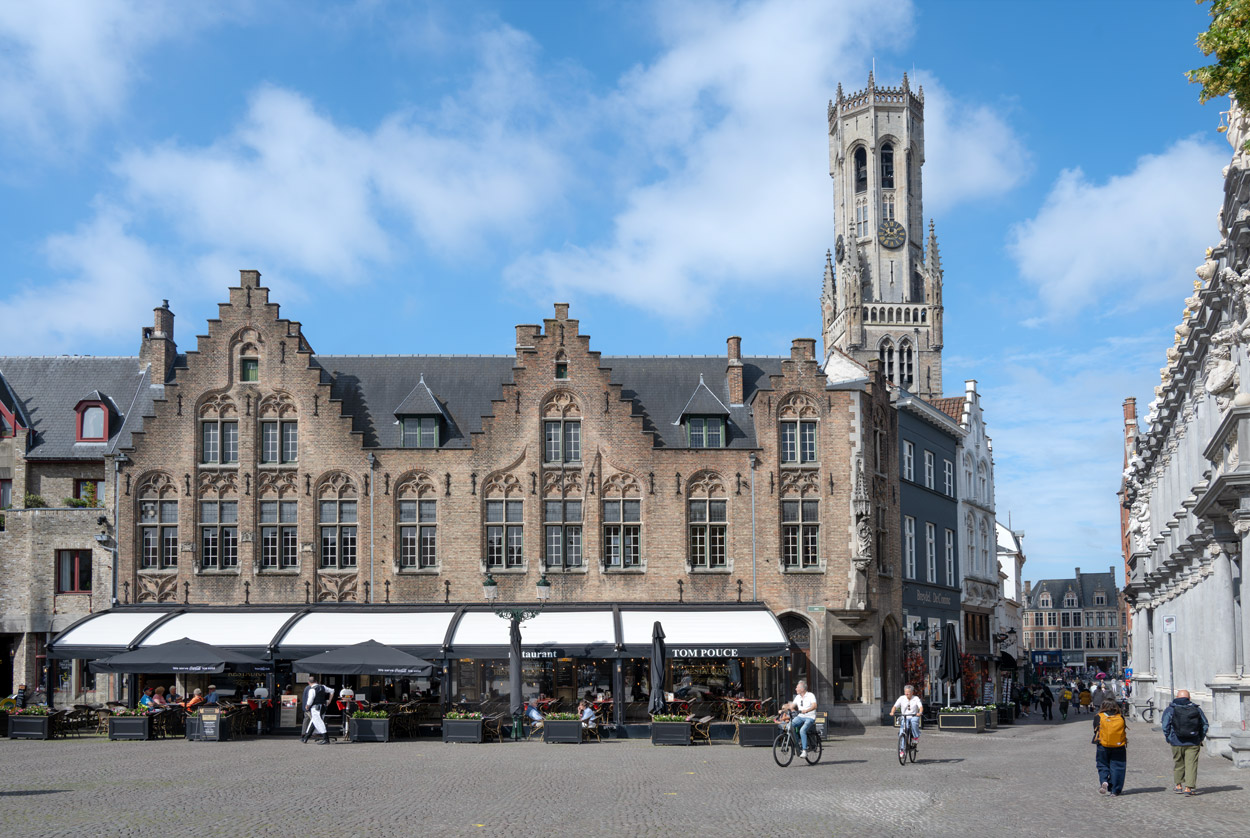
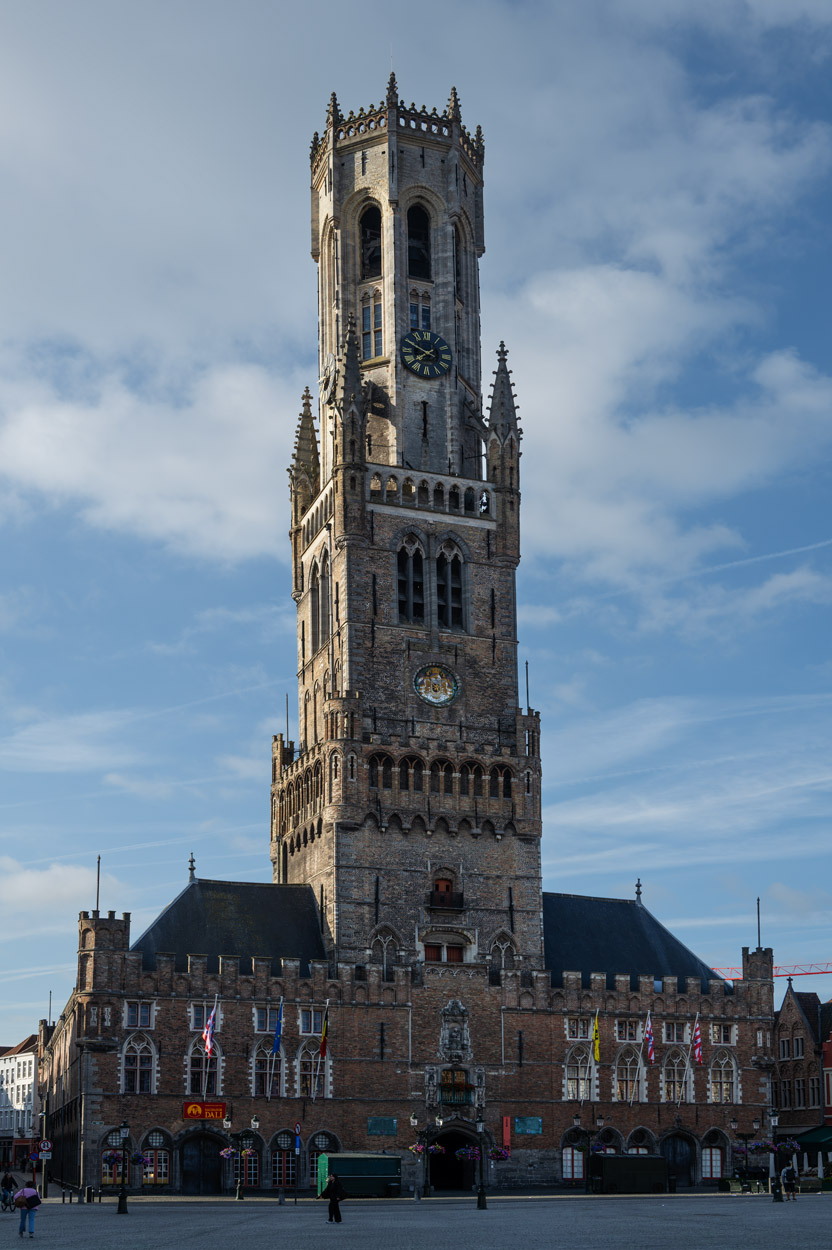
The Belfry of Bruges is the centerpiece of the Market Square. The tower, a mere 83 meters high was built in 1240, but has been damaged by fire and repaired several times since then.
I will have more about Bruges in the days to come.
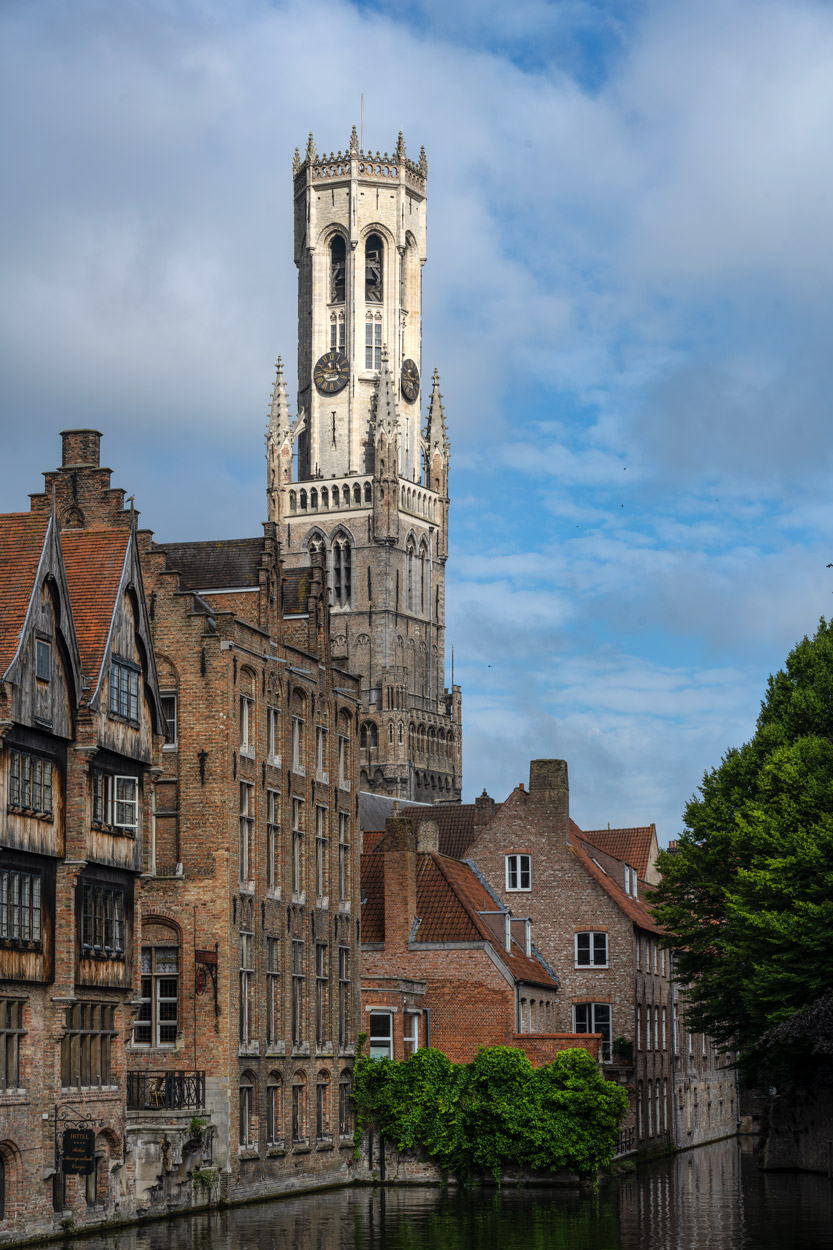
Belgium just happens to be on my mind right about now, so I decided to take a break from Denmark and the Danes today.
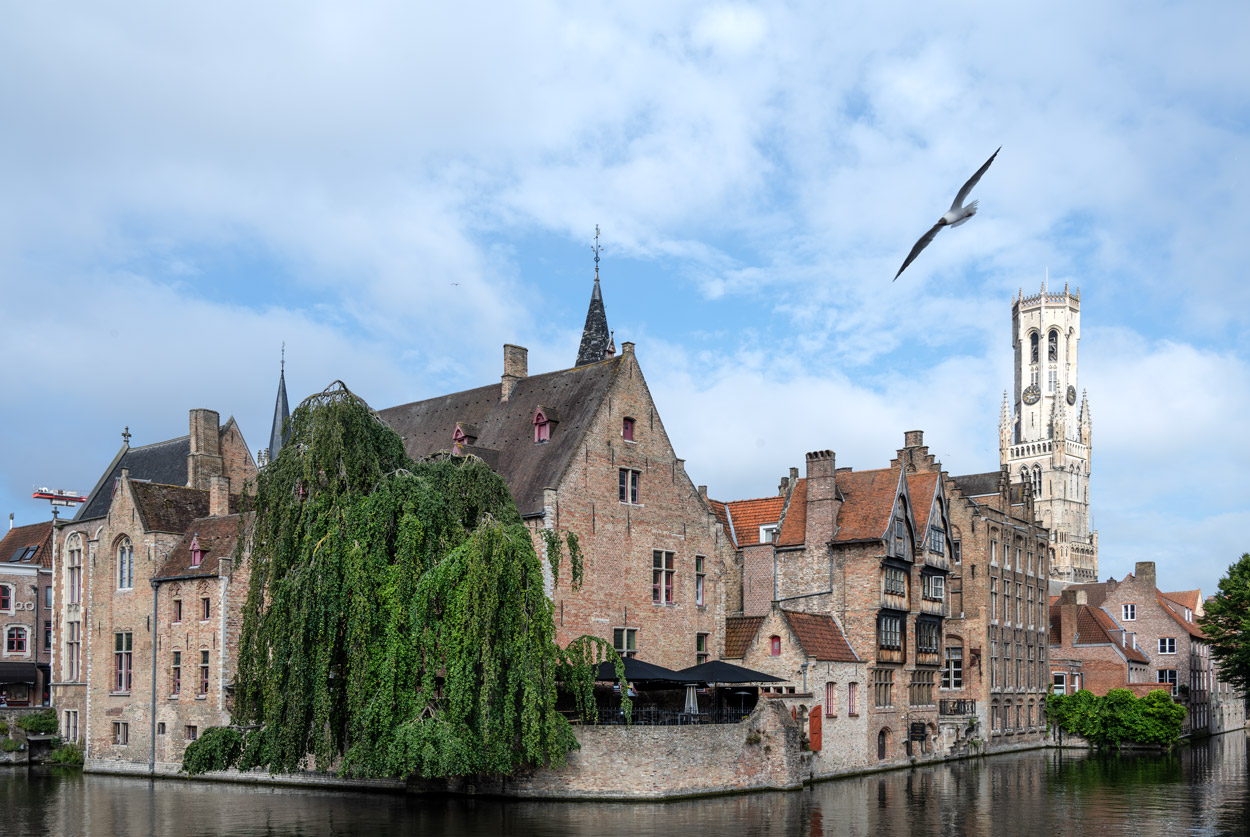
Bruges was the first city in northern Europe visited by merchant vessels from Genoa in the 13th century, becoming the endpoint of seaborne trade going through the Straits of Gibraltar, along the eastern Atlantic coastline, and through the English Channel to the low countries in the north. Today much of the center of old Bruges is a beautifully preserved UNESCO World Heritage site drawing tourists from all over Europe. The Belfry, visible from everywhere in the old city, stands in the Grote Markt in the center of Bruges.
As for Belgium being on my mind, I just finished watching that country’s national team defeat the US team 4 to 1 in a World Cup football match. While I sympathize with the US players who now have to come to terms with being beaten and knocked out of the World Cup competition, I can’t say I am put out or upset that the US lost. Given the performance of the garbage representing our country right now, the US does not deserve to win any accolades these days. It is as simple as that.
Belgium moves on to a Quarterfinal match with Spain on 11 July.