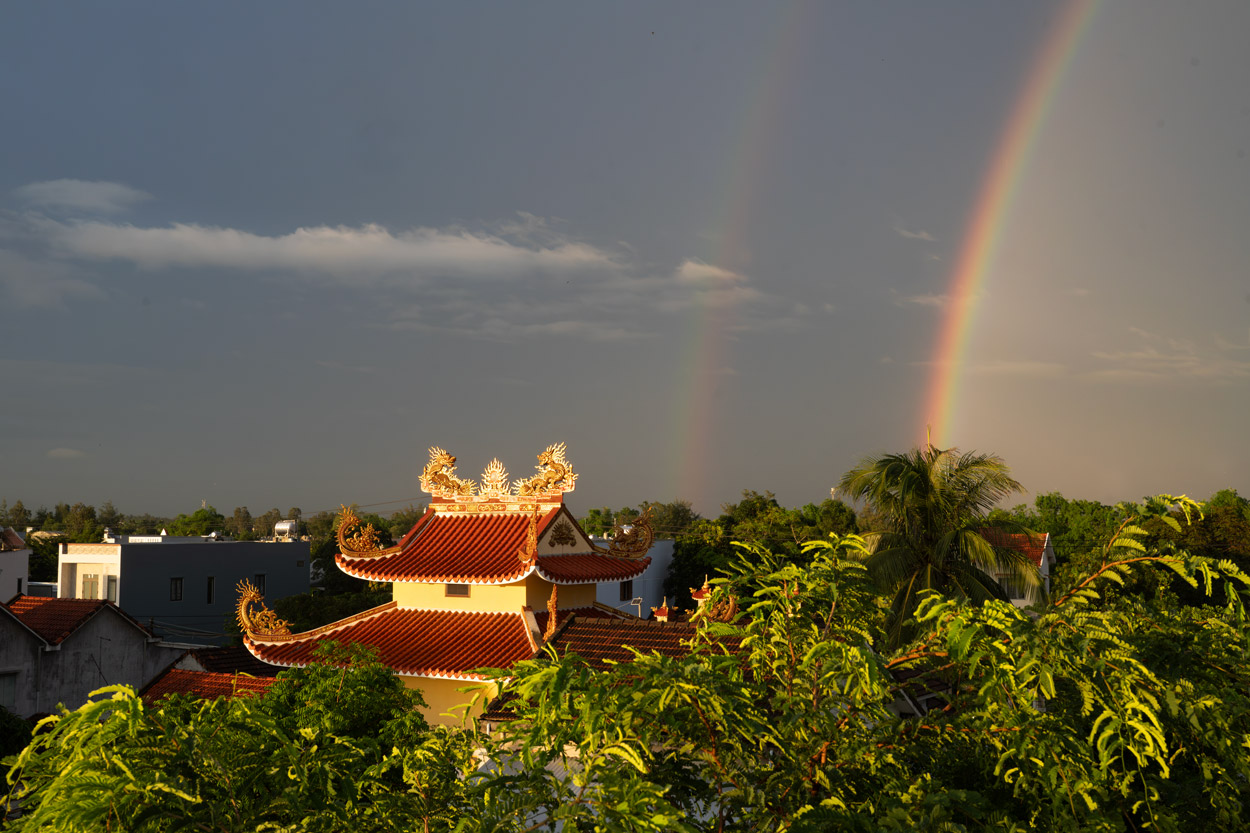
After a gloomy yesterday of rain and heavy overcast skies, the clouds suddenly cleared in time for the late afternoon sun to shine through. Complete with a rainbow! The patio on the 3rd floor of my house gave me a great view.
After a gloomy yesterday of rain and heavy overcast skies, the clouds suddenly cleared in time for the late afternoon sun to shine through. Complete with a rainbow! The patio on the 3rd floor of my house gave me a great view.
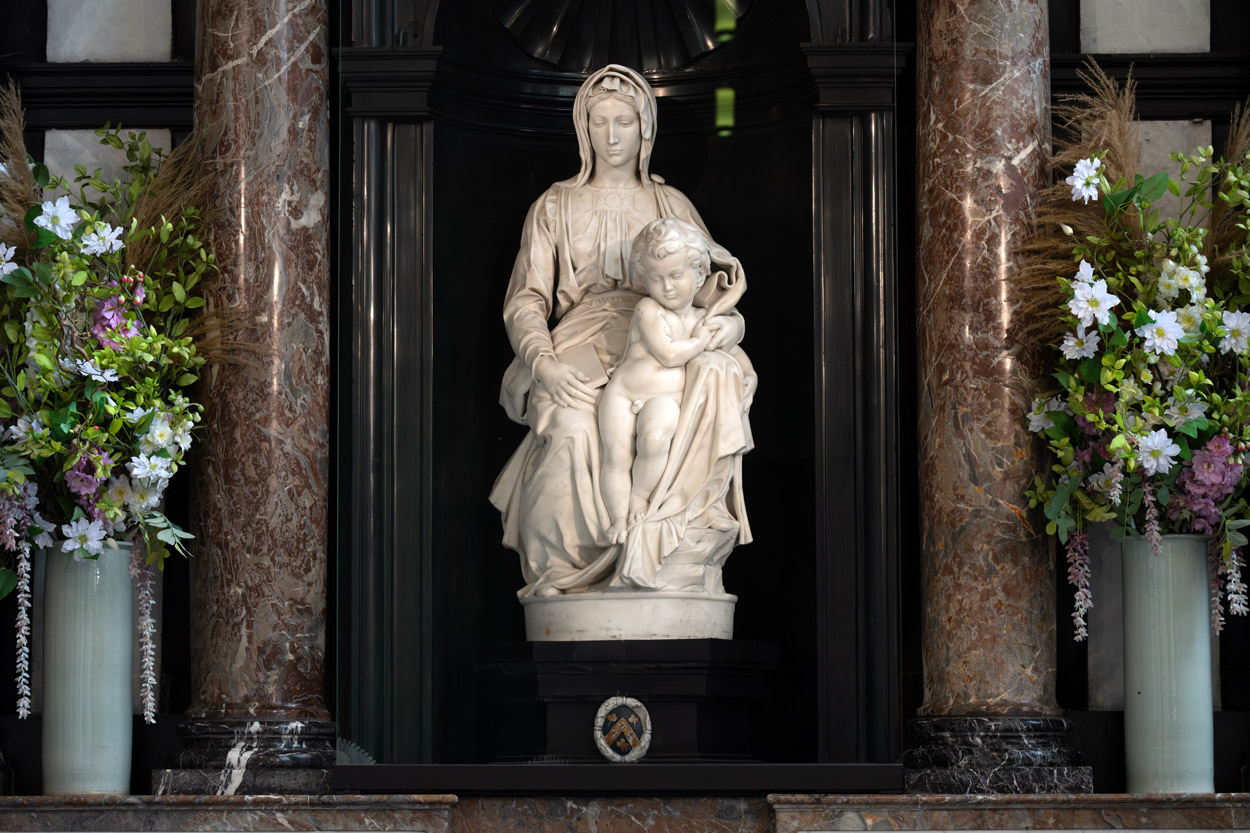
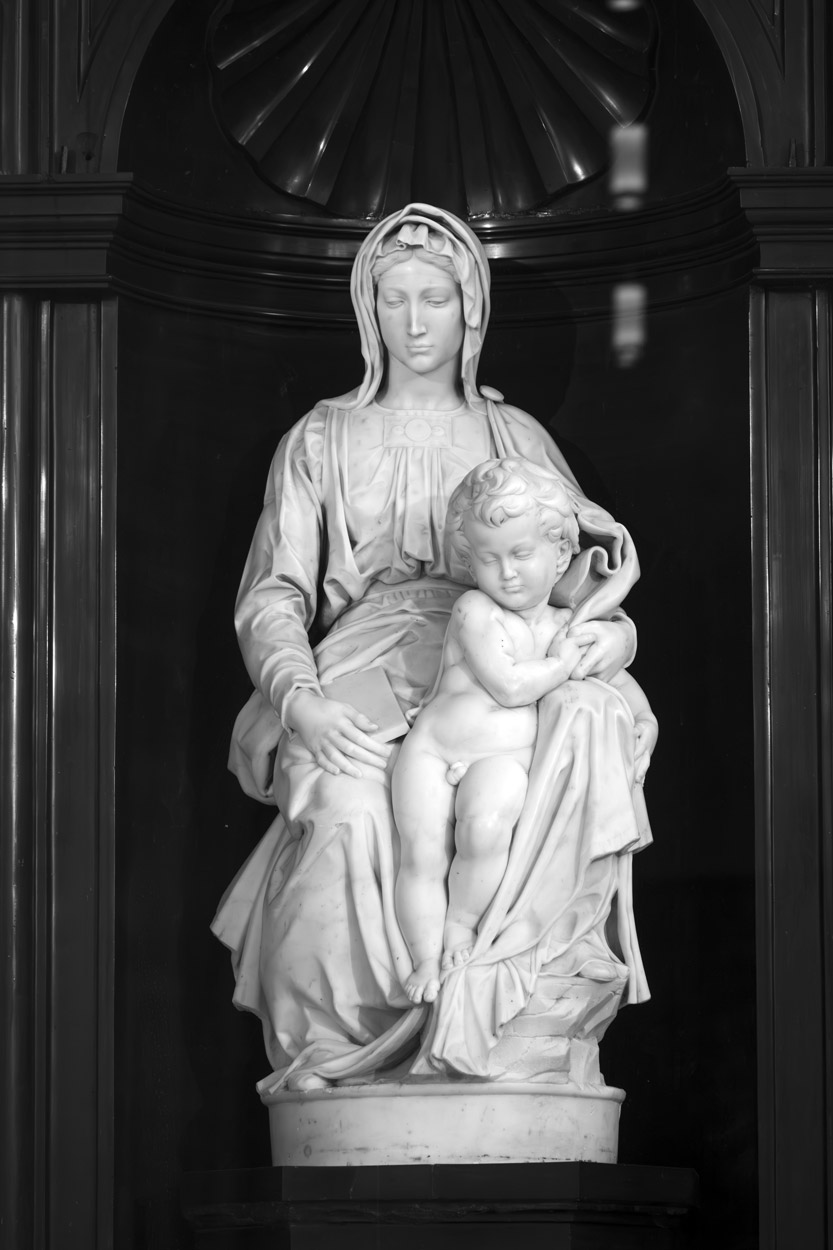
For me in any case, nothing better illustrates the historical prominence and wealth of Bruges than the magnificent Madonna and Child sculpture by Michelangelo on display in the Church of Our Lady. Wikipedia explains that the statue of Italian marble, completed in Italy in 1506, was destined for a location in Italy, but after a disagreement about money, Michelangelo sold the statue to the Mouscron brothers, two wealthy Bruges merchants. The Madonna was delivered to the buyers in Bruges and donated to its present home in 1514.
In fact Bruges played an oversized role in the revival of trade in Europe that began roughly in the 11th and 12th centuries. As European trade that had collapsed after the fall of the Western Roman Empire began to expand and flourish, Bruges for a time was northern Europe’s wealthiest leading city. In the third volume of his Civilization and Capitalism, 15th to 18th Century, French historian, Fernand Braudel, writes of Bruges:
It was all to culminate in the dazzling fortune of Bruges. By 1200, this city […] was included in the circuit of the Flemish fairs. This in itself made Bruges a more important place: she was receiving foreign merchants, her industry was thriving and her trade was reaching England and Scotland where she found the wool needed both for her looms and for re-export to the cloth-making towns of Flanders. […] And finally the arrival in Bruges of Hanseatic ships confirmed and developed her prosperity.
In 1277, the first Genoese ships put in to Bruges. The establishment of a
regular maritime link between the Mediterranean and the North Sea ushered in a decisive invasion by the southerners for the Genoese were but a foretaste of what was to come: the last of the newcomers, the Venetian galleys, arrived in 1314. […] But it was also a new departure [for Bruges] in the sense that the arrival of the sailors, ships and merchants of the Mediterranean brought in a wealth of goods, capital, and commercial and financial techniques. Rich Italian merchants came to live in the city, and brought with them consignments of some of the most precious commodities of the time: spices and pepper from the Levant which they exchanged for the industrial products of Flanders.
Thus Bruges came to be the centre of a huge trading area, covering no less than the Mediterranean, Portugal, France, England, the Rhineland, and the Hansa.
(Braudel, Fernand, tr. from the French by Siân Reynolds, Civilization and Capitalism 15th-18th Century, Volume III, The Perspective of the World, Harper & Row, New York, 1984, p99)
My interest in Europe’s medieval and early modern history, fueled by scholars like Braudel, got me to Bruges in the first place. I was curious and wanted to take a look. The fact that the old part of the city is a beautifully preserved, magnificent UNESCO World Heritage Site was unexpected and most welcome icing on the cake.
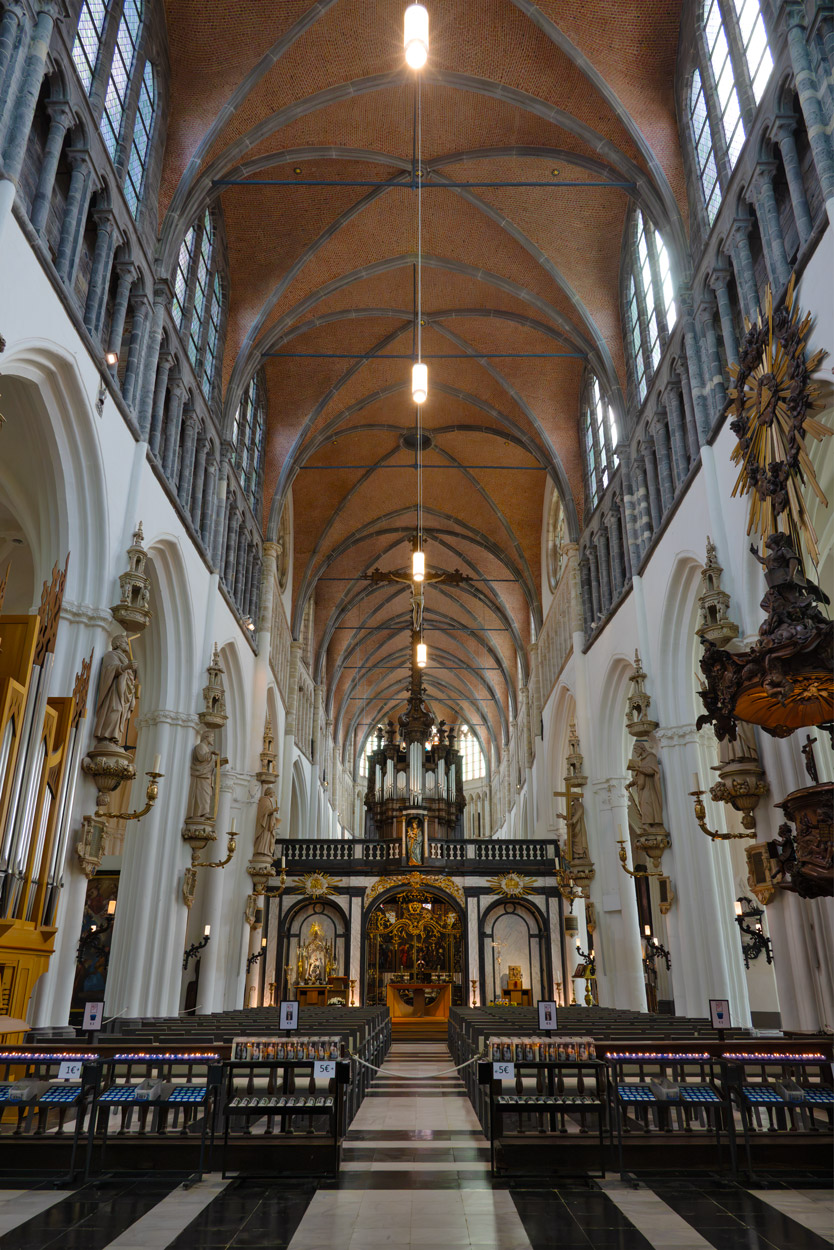
The sanctuary of the Church of Our Lady is open to the public for viewing, and like so many venerable European churches, it is impressive in and of itself. This church, however, has a part of its ground floor set aside as a museum that, if I am not mistaken, I paid €10 to enter. There was virtually nobody about when I walked around; I enjoyed an almost private viewing of the Michelangelo masterpiece. Given the crowds that often surround works by well-known artists, I was both surprised and grateful to have some quiet time in the presence of genius.
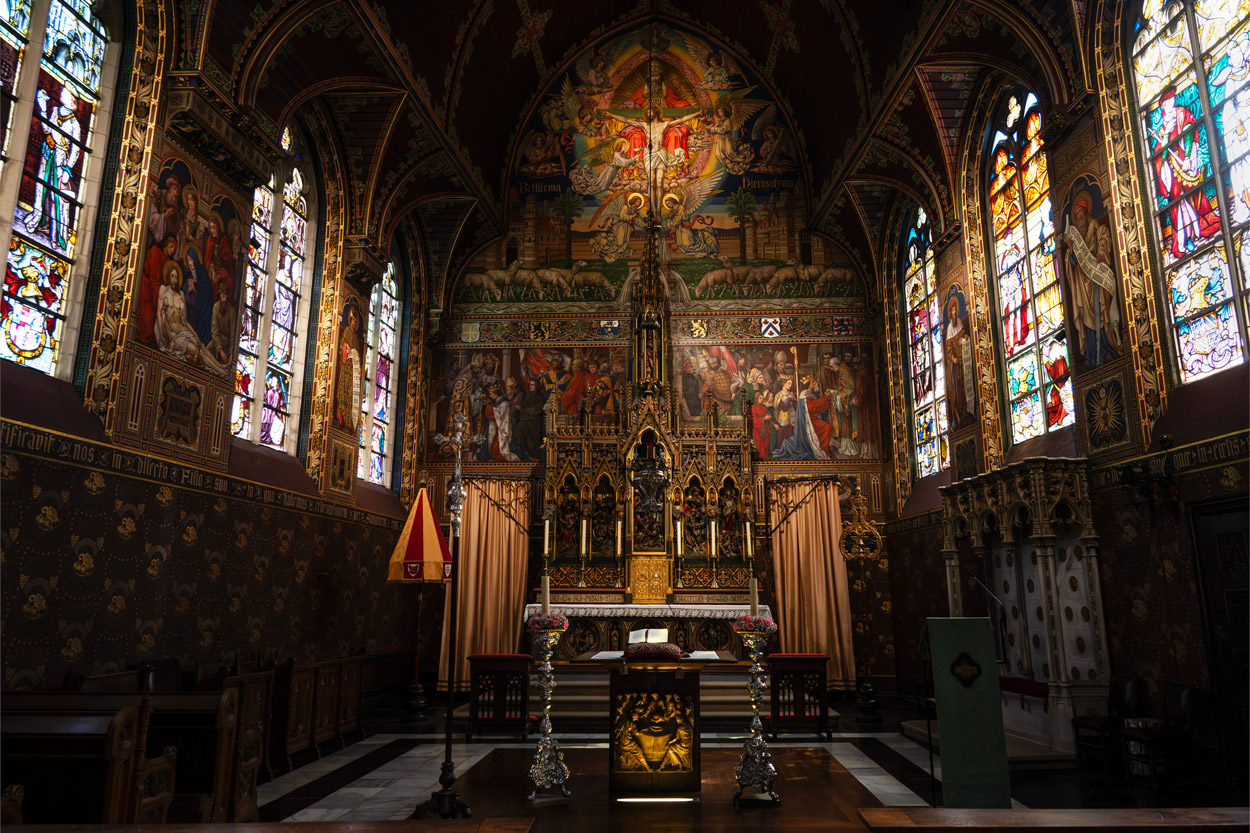
The exterior of the Basilica of the Holy Blood, next to Bruges City Hall in Burg Square, does not really look much like a church from the outside. There were people, obviously of the tourist persuasion, walking up a few stairs and through an entrance way; I was curious and followed them in. Inside, I saw a sign identifying the place at the foot of more stairs. I headed up and eventually walked into the remarkable main chapel, the Gothic style of which is somewhat unlike anything I have seen in the many churches I have visited over the years. Apparently, the church is home to a relic of the Holy Blood that a couple of bozos brought back from the Holy Land at some point. Make whatever you want of that. The church was built in the 12th century.
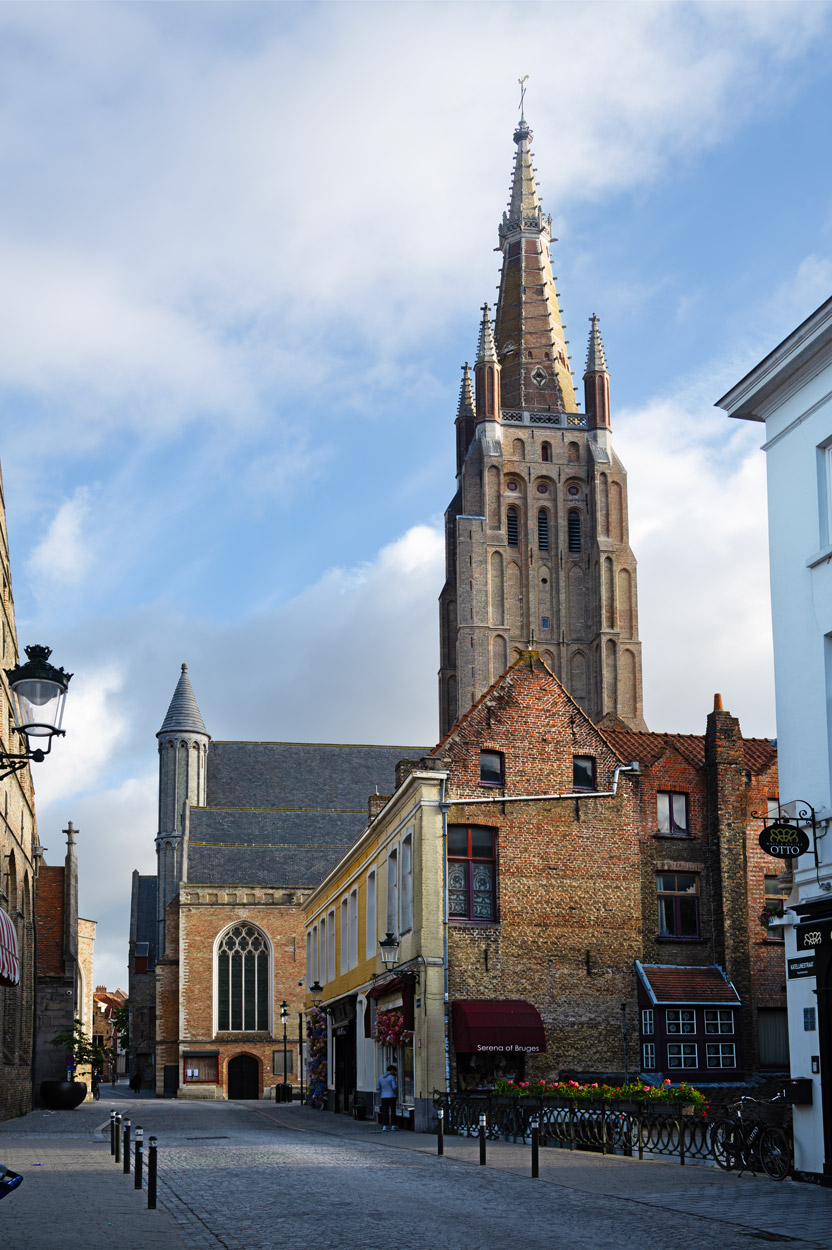
On my first morning in Bruges, I set off at just past 7:00 am to walk to the center of the old city. I soon came upon the enormous 115.6m high tower of the Roman Catholic Church of Our Lady. Construction of the Gothic church began in the 13th century and was completed in the 15th century. The brickwork tower is the second highest such structure in Europe (or the third, depending on which source one chooses to believe). Whether second or third, the massive tower dominates its surroundings.
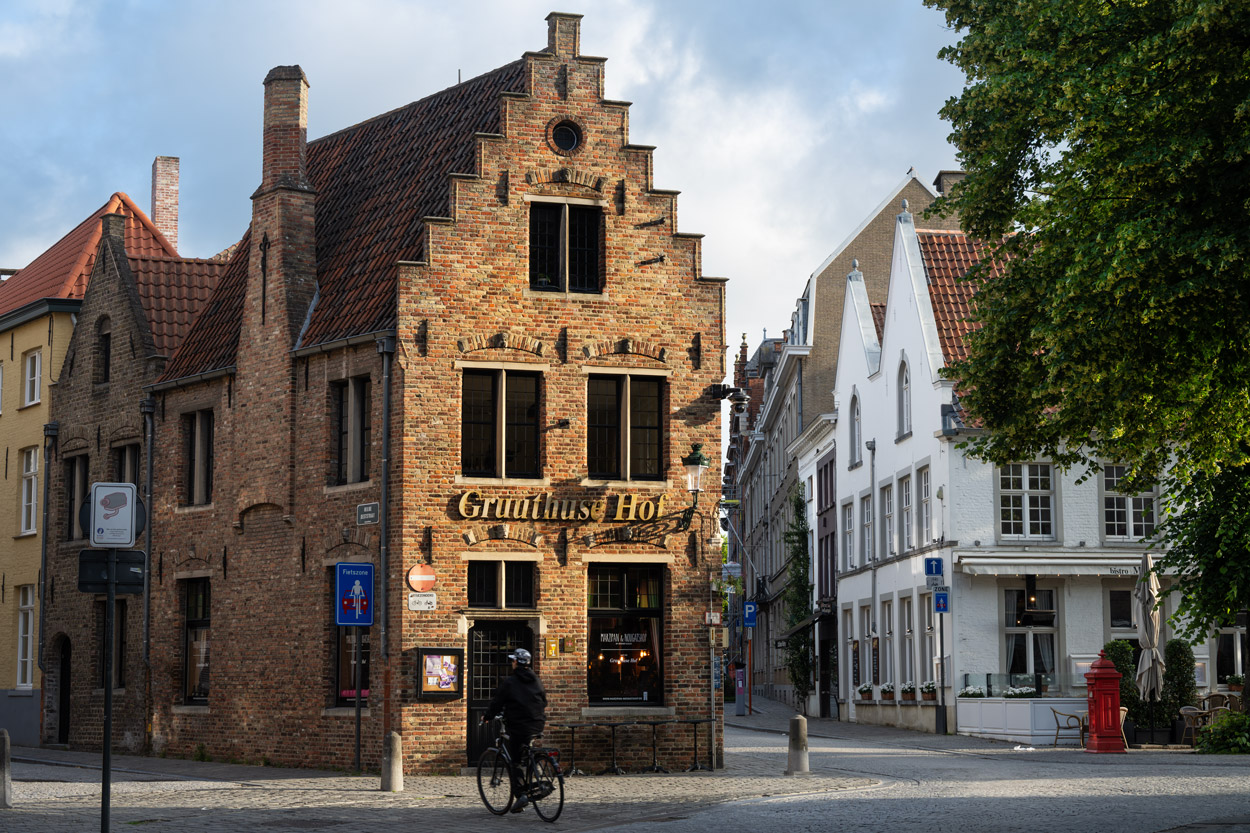
Bruges is a small Belgian city of about 120,000 people located on the North Sea in the northwest of the country near the Dutch border. The center of Bruges is part of a sizeable UNESCO World Heritage Site of some 430 hectares. My plan was to walk from my hotel near the southern end of the oval-shaped Site to the Markt or Market Square, about 1 kilometer away in the heart of historic old Bruges.
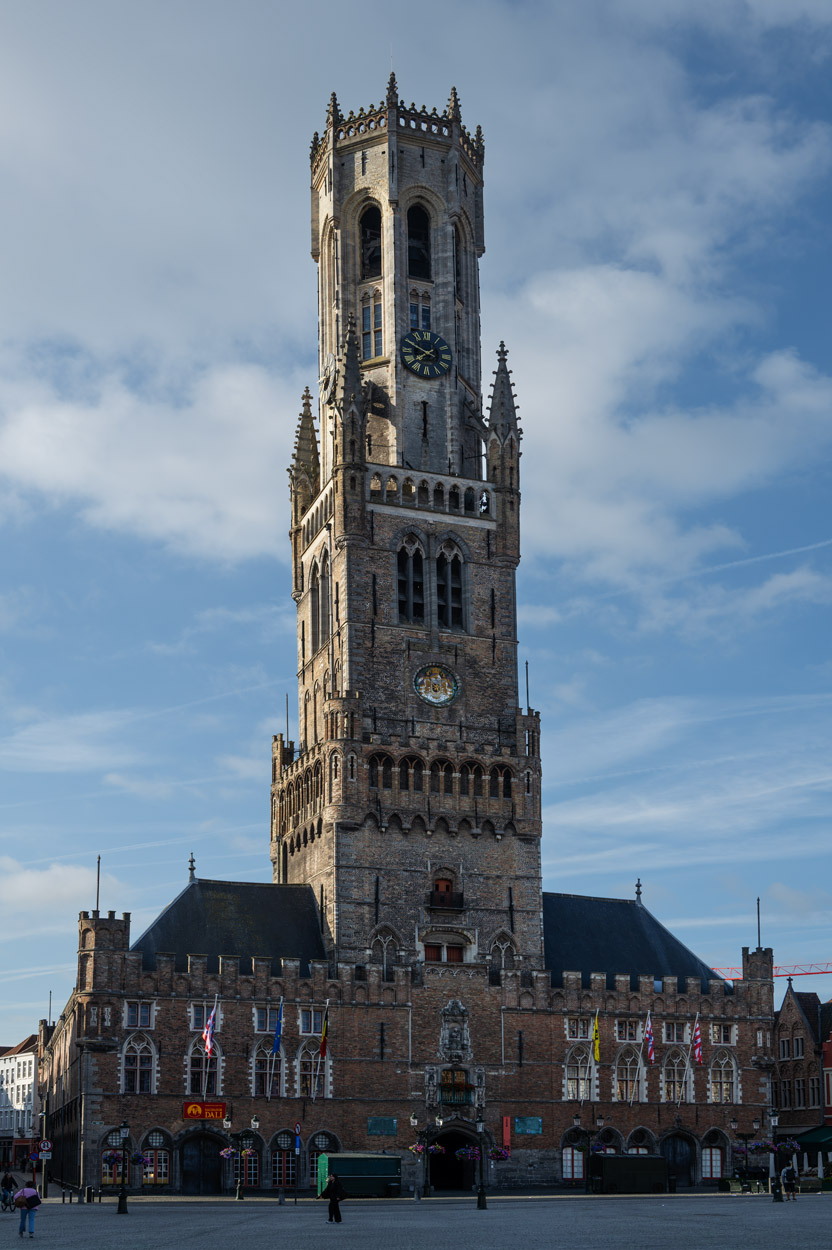
The Belfry of Bruges is the centerpiece of the Market Square. The tower, a mere 83 meters high was built in 1240, but has been damaged by fire and repaired several times since then.
I will have more about Bruges in the days to come.
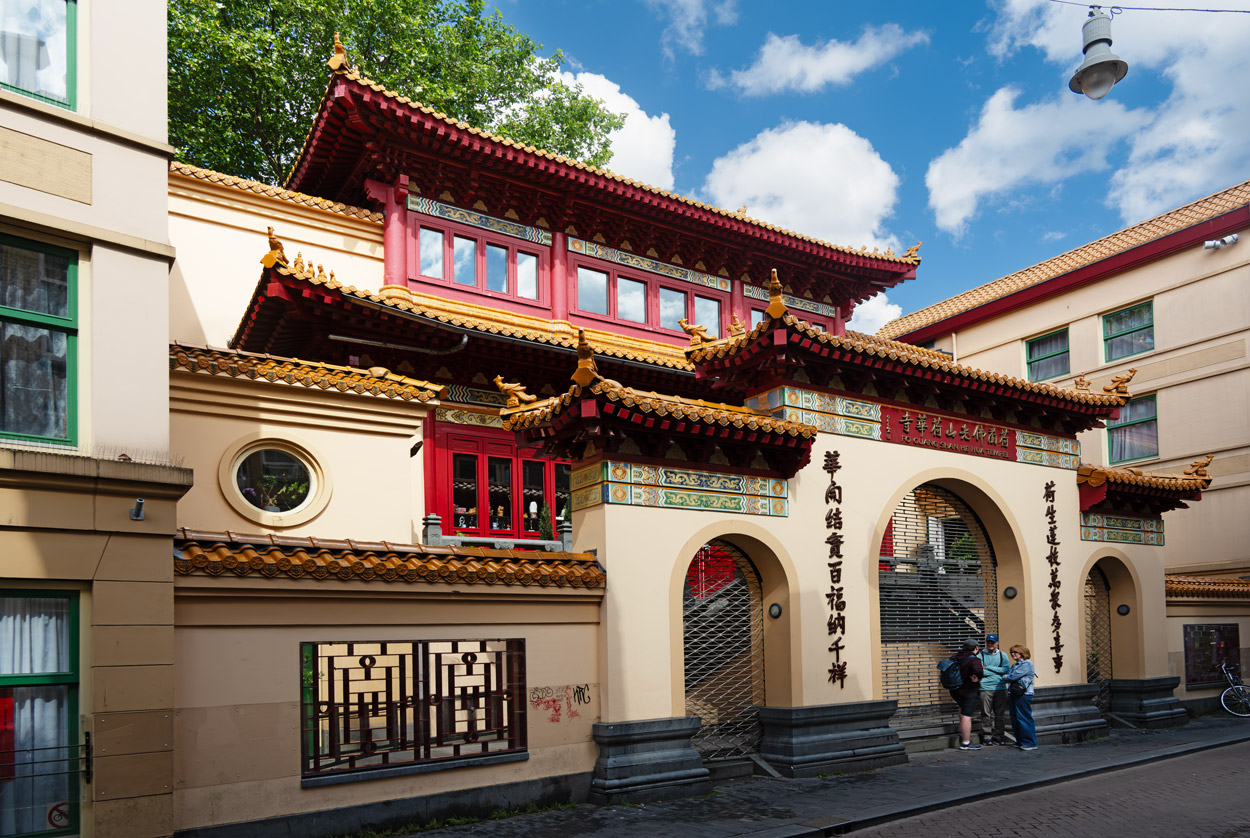
I was walking, day dreaming, along a narrow, bricked, rather non-descript Amsterdam street when I looked up and saw Chinese characters on the wall of a building. I was disoriented for a moment wondering what this place was doing in the middle of Amsterdam, realizing seconds later that I had walked into Amsterdam’s Chinatown.
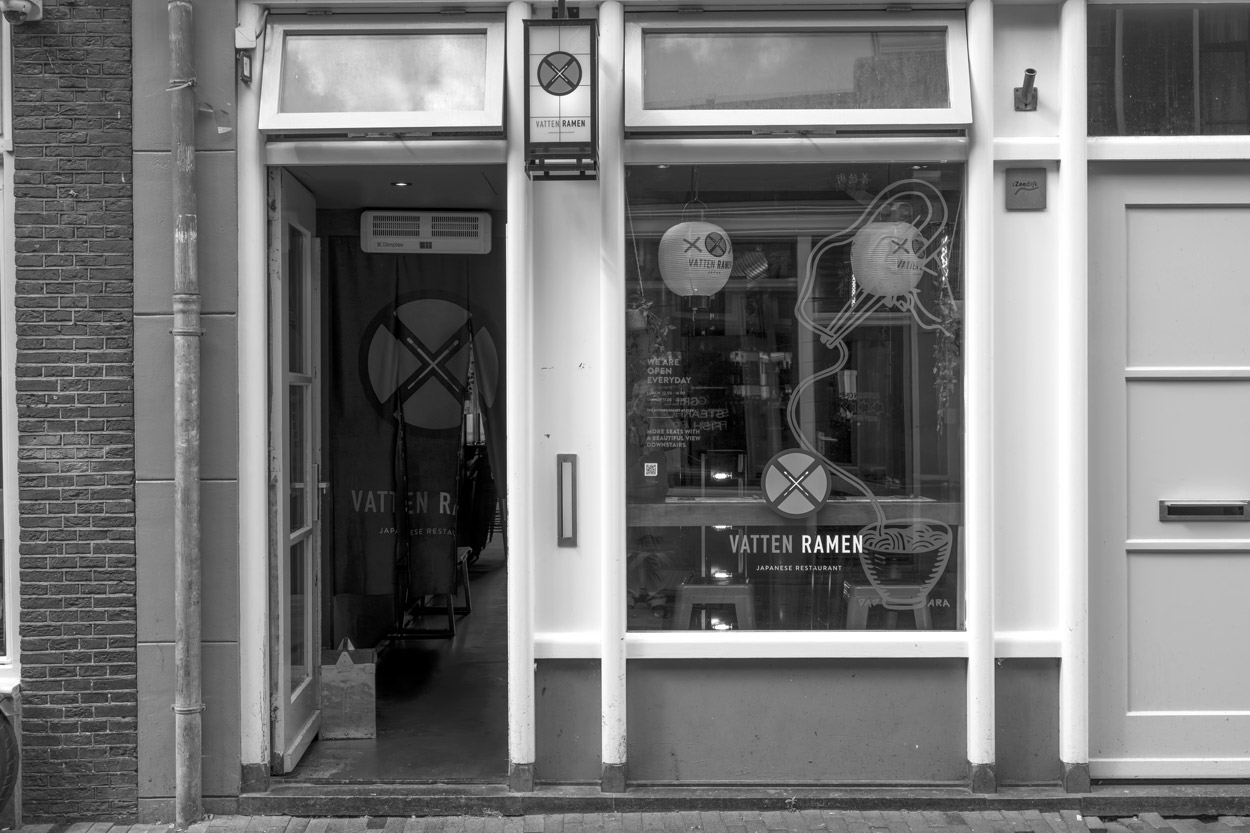
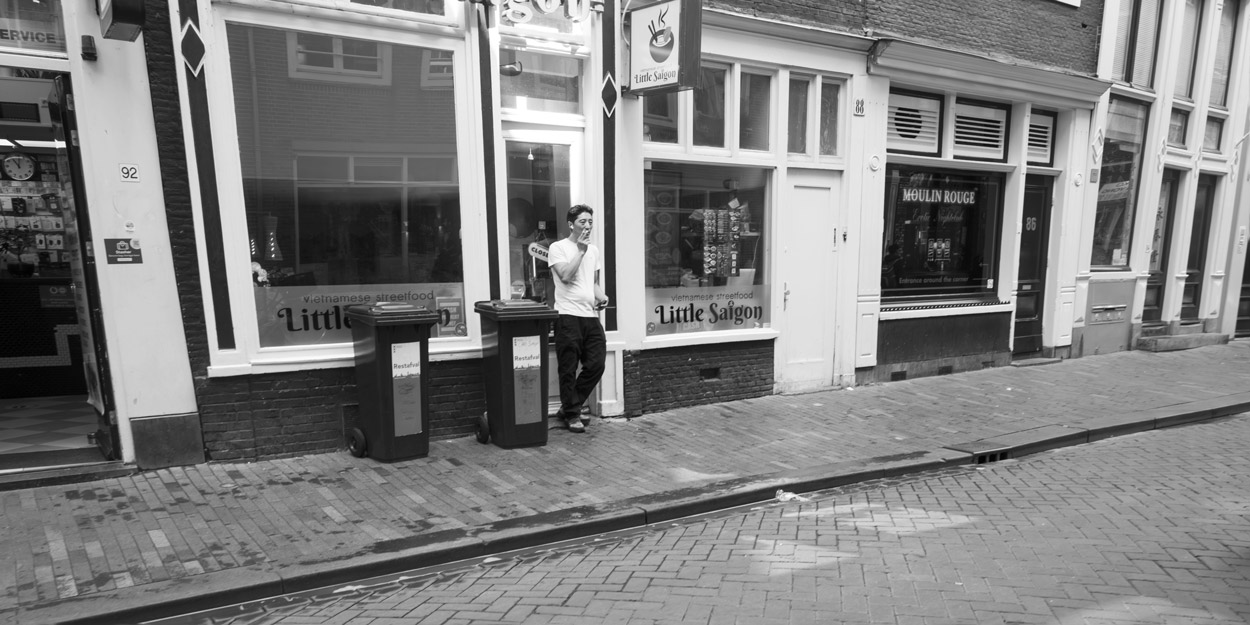
In fact the name Chinatown is something of a misnomer, as this small area contains restaurants serving all kinds of East and Southeast Asian cuisines. My quick, very unscientific survey suggested there were more Ramen shops that anything else. There may have been some Asian markets as well, though to be honest the only shop I noticed was dishing up snacks laced with cannabis. My pot days are very long gone at this point, though I did try edibles a couple of times in the past. They put me to sleep.

I was not tempted to eat anything in Chinatown. Or Asiatown, call it what you will. Prices are crazy and the food served up is generally not nearly as good as what I get closer to home for a fraction of the price.
I booked a ticket online to visit Amsterdam’s Rijksmuseum at 9:00 am on 9 June, my first full day in Amsterdam. The museum was a couple of clicks from my hotel along the Singel canal, so I set out around 7:00 to walk on a beautiful Tuesday morning.
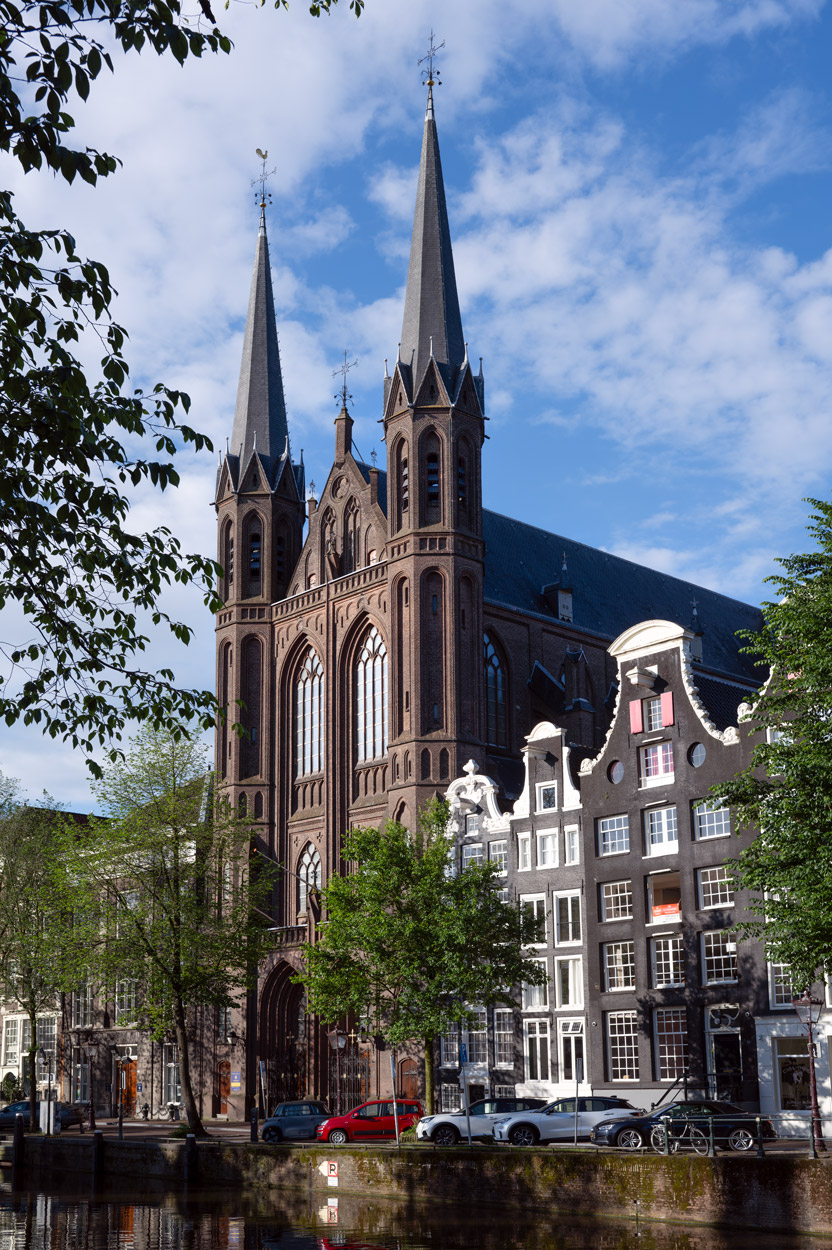
About half way to the museum I was nearing the point where I would turn off the Singel when I came across the Roman Catholic De Krijtberg Church. The Neo-Gothic church with its two towers dominates this stretch of the canal. There has been a church on this site since 1654; the building pictured here, formally named the Church of Saint Francis Xavier, was opened in 1881.
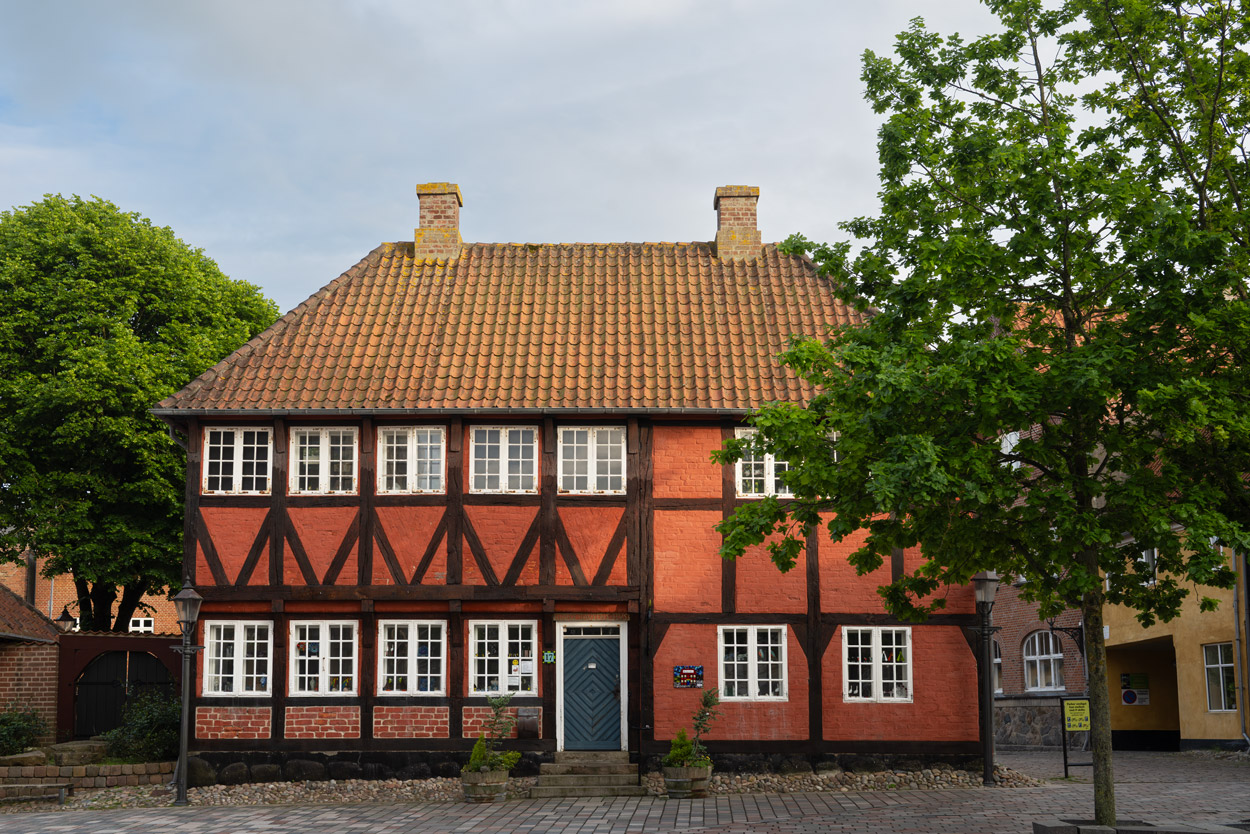
The 16th century Hans Tausen’s House was part of the residence of bishops seated at the Ribe Cathedral. It is located in the village square facing the cathedral.
Hans Tausen, bishop of Ribe from 1542 to 1561, was a well-known reformer in the Lutheran church. He translated the Bible into Danish.
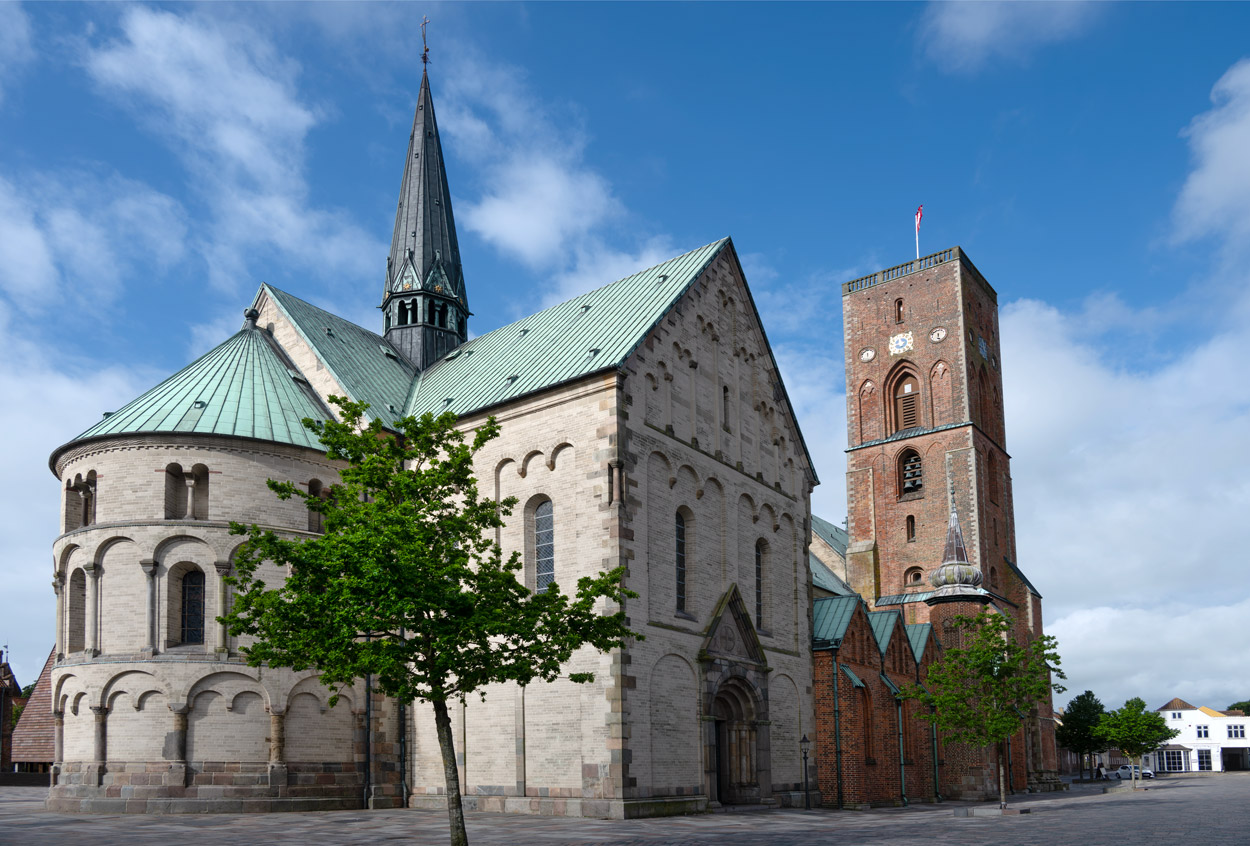
A number of online travel guides bill Ribe, a town on Denmark’s west coast with a few more than 8000 inhabitants, as Denmark’s oldest town. This is very likely the case as Ribe was already a center of commerce and trade early in the 8th century during the age of the Vikings, and people have lived in the village continuously since then.
With its beautifully preserved and restored buildings in a quiet village setting, today Ribe is a popular tourist destination for Danes, Germans, and other Europeans. The Ribe Cathedral sits at the center of the old town square and dominates its surroundings. The first church in Ribe, built of wood, was founded in 860 and apparently at that time a community of Christians lived together in Ribe with the pagan Vikings. The first stone church on the site was completed in the 12th century. Begun as a Roman Catholic church, today the cathedral is part of the Church of Denmark, which I think is a flavor of the Lutheran denomination. If Wikipedia is any guide, the history of the cathedral, from inception to today, is a tale of sectarian strife, conflict, and mayhem, the bread and butter of religion as far as I am concerned, accompanied by fires and other natural disasters.
Be that as it may, I readily admit that I am fascinated with church architecture. The amount of thought, creative energy, devotion, and monumentally difficult labor that went into building and adorning ancient and medieval churches is downright astonishing.
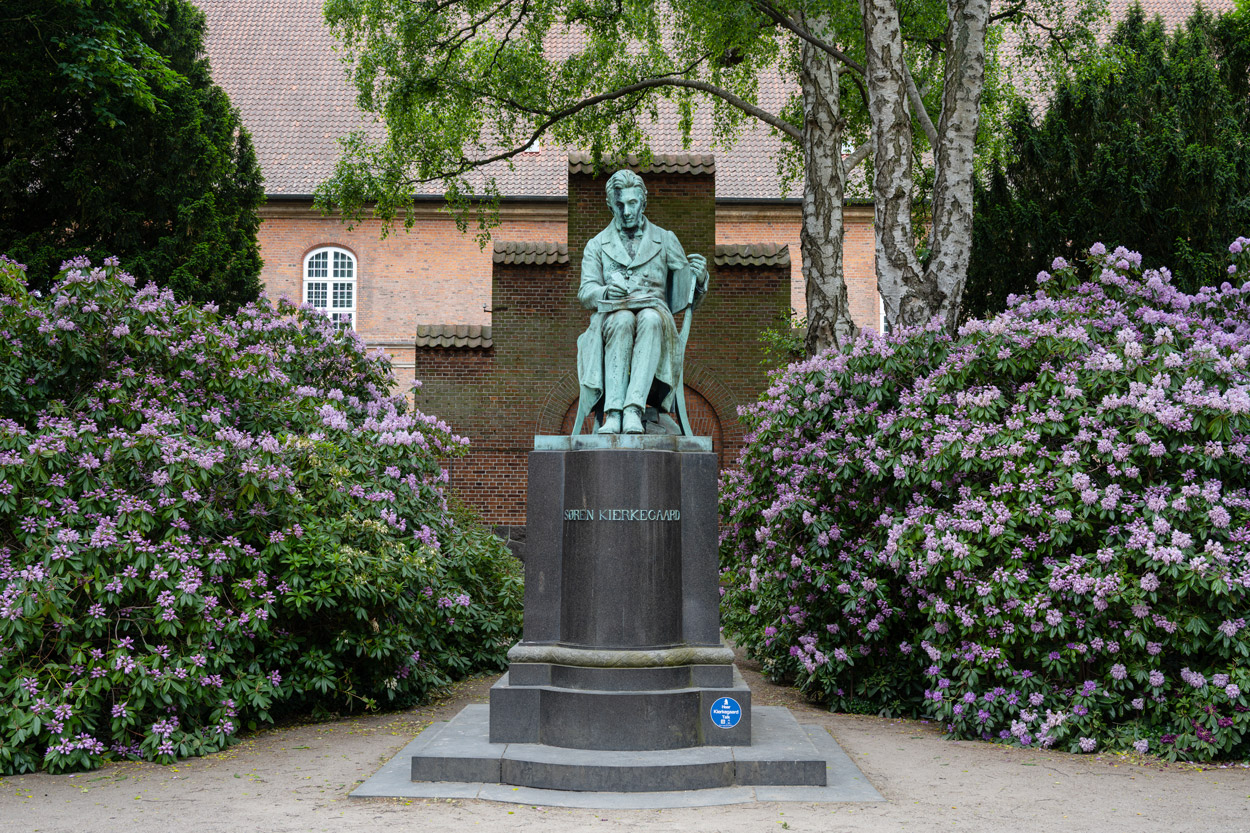
Søren Kierkegaard. Words like philosopher and theologian came to mind when I saw this statue in Copenhagen’s beautiful Royal Library Garden. I read the first paragraph of Kierkegaard’s Wikipedia entry. This told me the man was a prolific thinker writing about a wide range of topics – I did not read the lengthy article introducing his works – and is considered to have been the first existentialist philosopher. His was a name my dad dropped from time to time during his years at Harvard in the early 1960s, and that is most likely when I first heard of Kierkegaard.
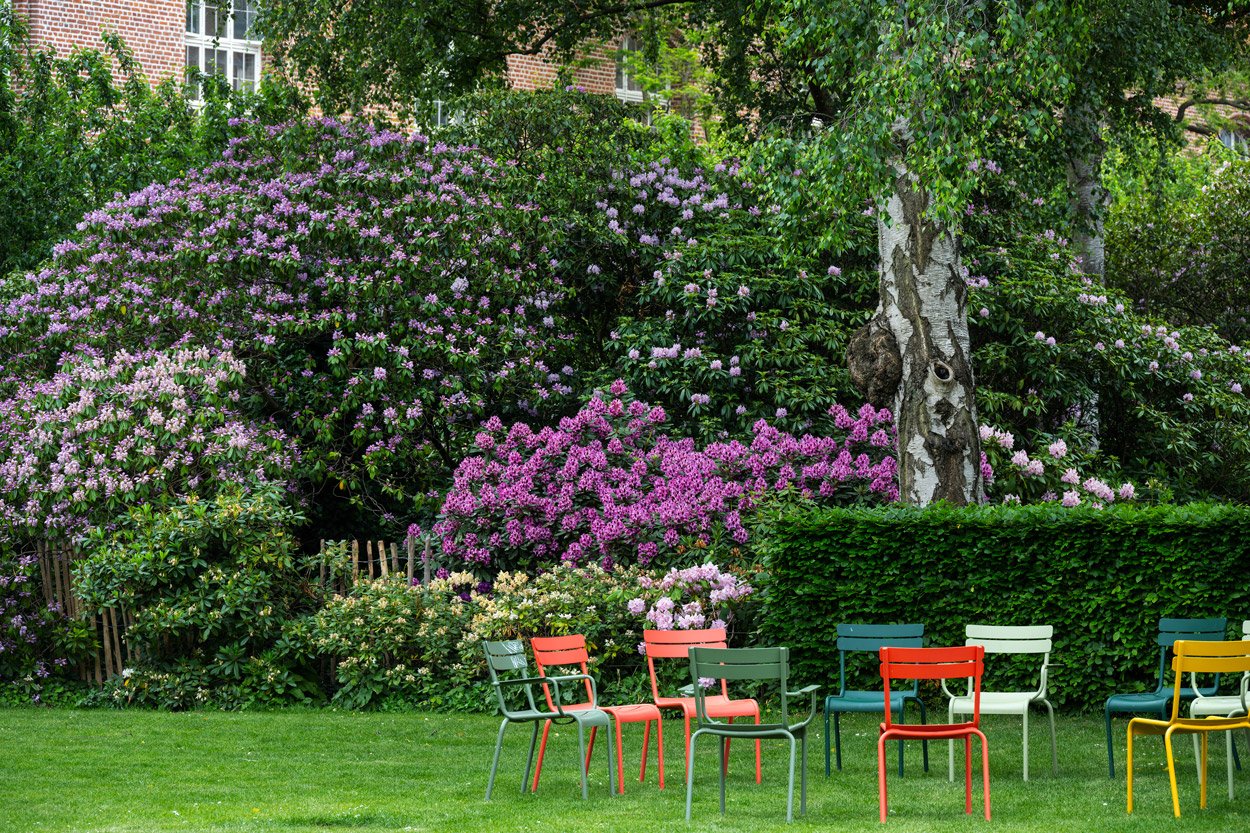
The Royal Library Garden is a quiet, restful place, and I had been sitting on a bench near Kierkegaard for quite some time when a group of Chinese tourists walked into the area around the statue. They immediately began standing in front of Kierkegaard and posing for photos with hands raised in V salutes. I amused myself wondering how many, if any, of these Chinese had ever heard of Kierkegaard or knew anything of his work. Of course, it is very possible most of them knew more than I did. Be that as it may, I wanted to get a picture of this photo taking, but doing so would have required me to get in the face of some of the group. I was not inclined to do that and remained sitting on my bench.
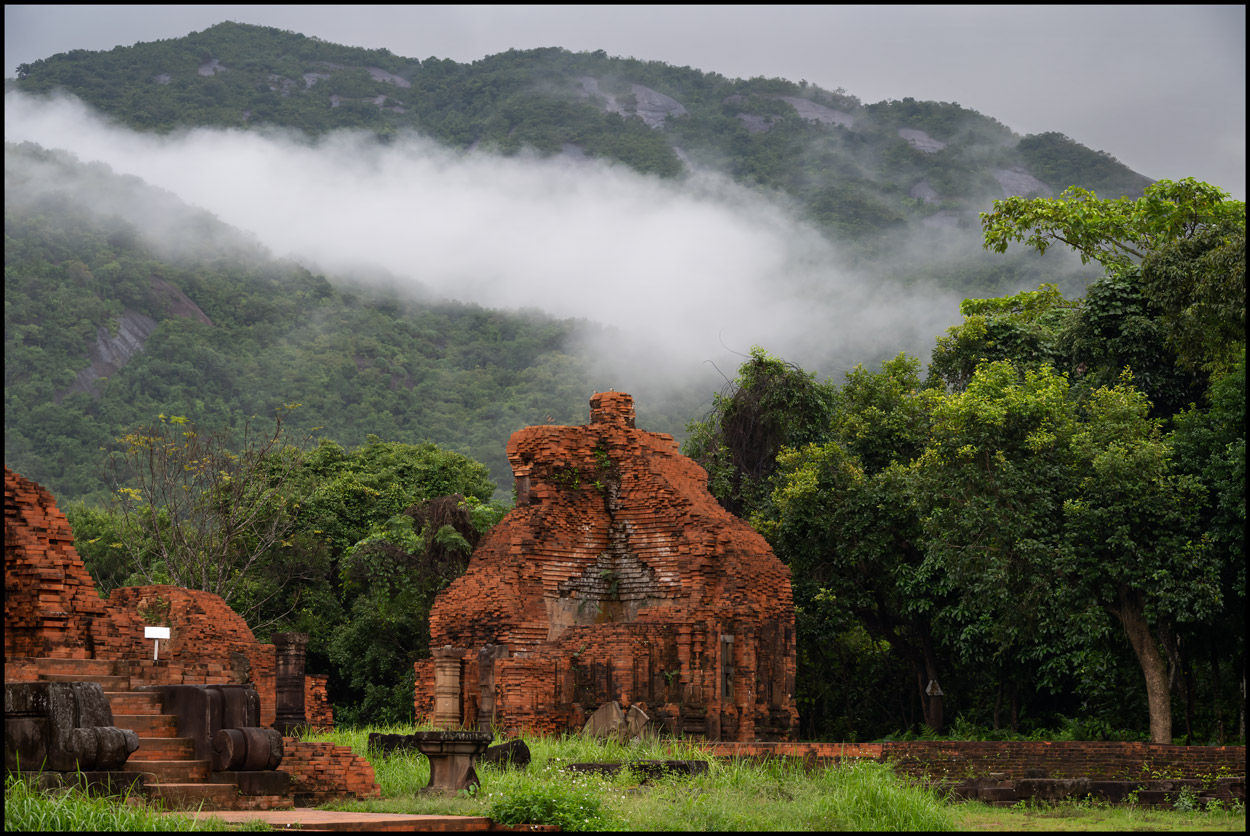
About one hour to the west of Hoi An, the UNESCO World Heritage Site, Mỹ Sơn, was an important religious center of the Cham people. The earliest Cham settlements in what is now central and southern Vietnam date back to the 3rd century CE. At some point early in their history, the Cham came into contact with Hinduism and adopted some variant of that religion. While there is debate about the extent to which the Cham in Vietnam were a unified kingdom, there is no question that Cham polities functioned throughout much of Vietnam for hundreds of years. They were traders and seafarers – Hoi An was originally a Cham port city and trading center – who developed a sophisticated civilization that presented formidable challenges to the Vietnamese living in the northern part of today’s Vietnam. For many years, there were ongoing conflicts and wars between the Cham and the Vietnamese. As the Vietnamese moved south, they eventually overran the Cham and absorbed their culture, though it was not until the 19th century that the last Cham enclaves were subdued.
Vietnamese friends have told me that the Cham people have been completely assimilated into the Vietnamese nation. While I suspect that is largely true, I have read that there is still a small, distinctly Cham ethnic minority in the country. How and to what extent Cham culture and customs have influenced the development of Vietnamese culture, I simply do not know enough about the very complex history of interaction between to two peoples to comment.
I have made two trips to My Son. The first time I went, it was a cloudy gray day. The second time I went, it was a cloudy and raining gray day. The photo above is from my second visit in November of 2024.