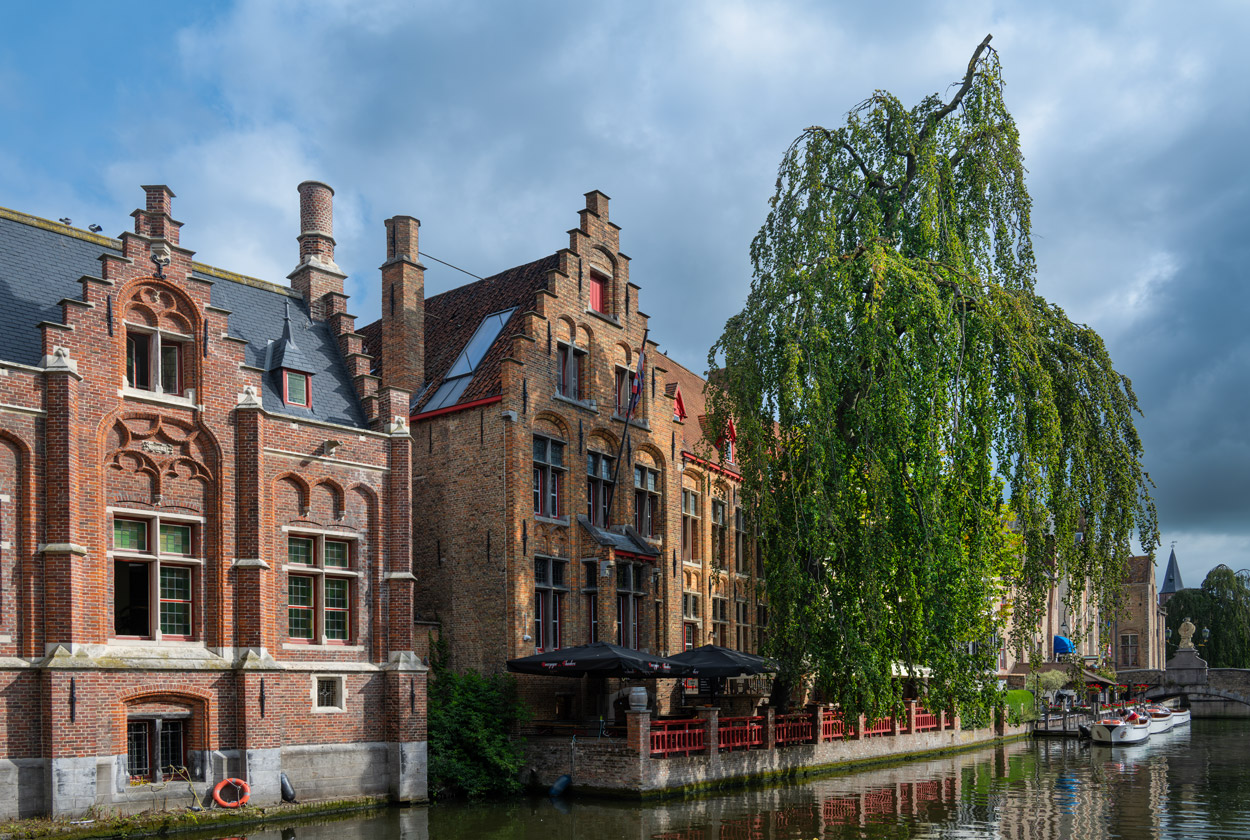
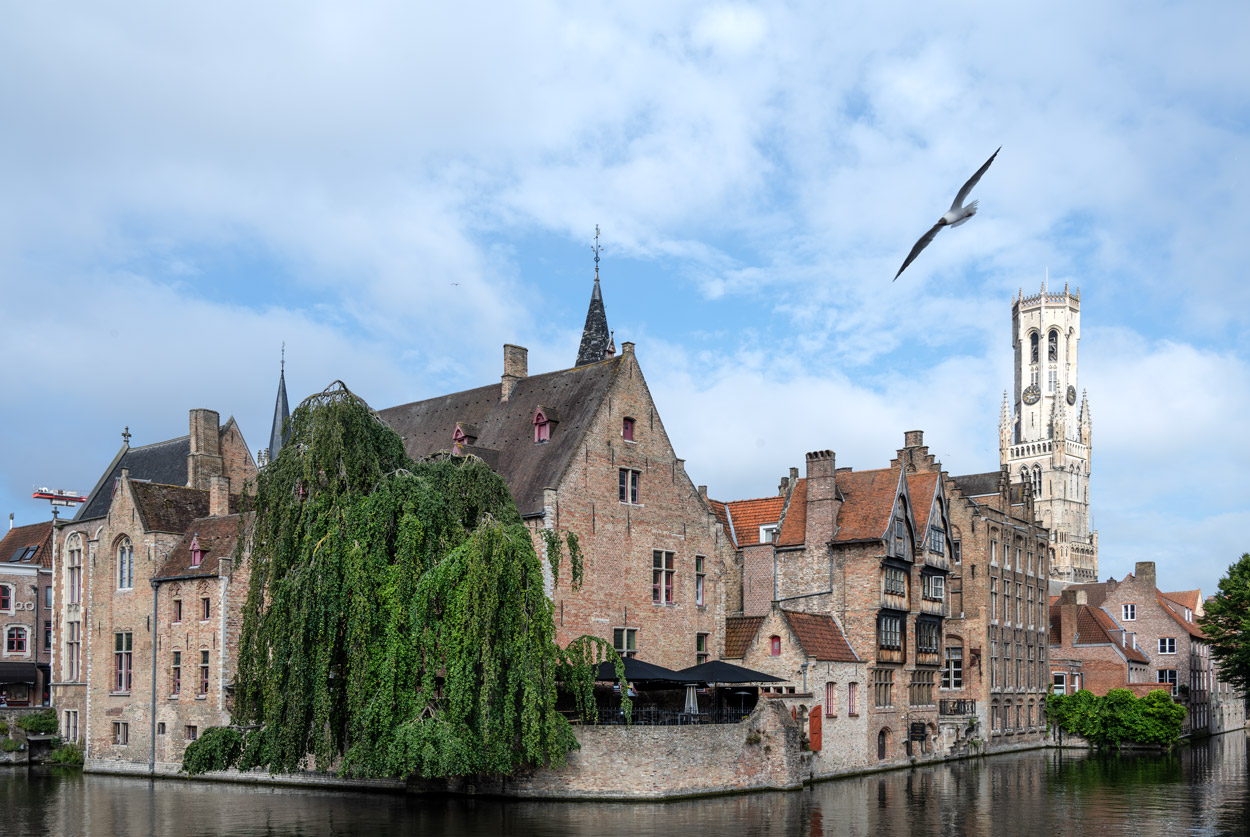
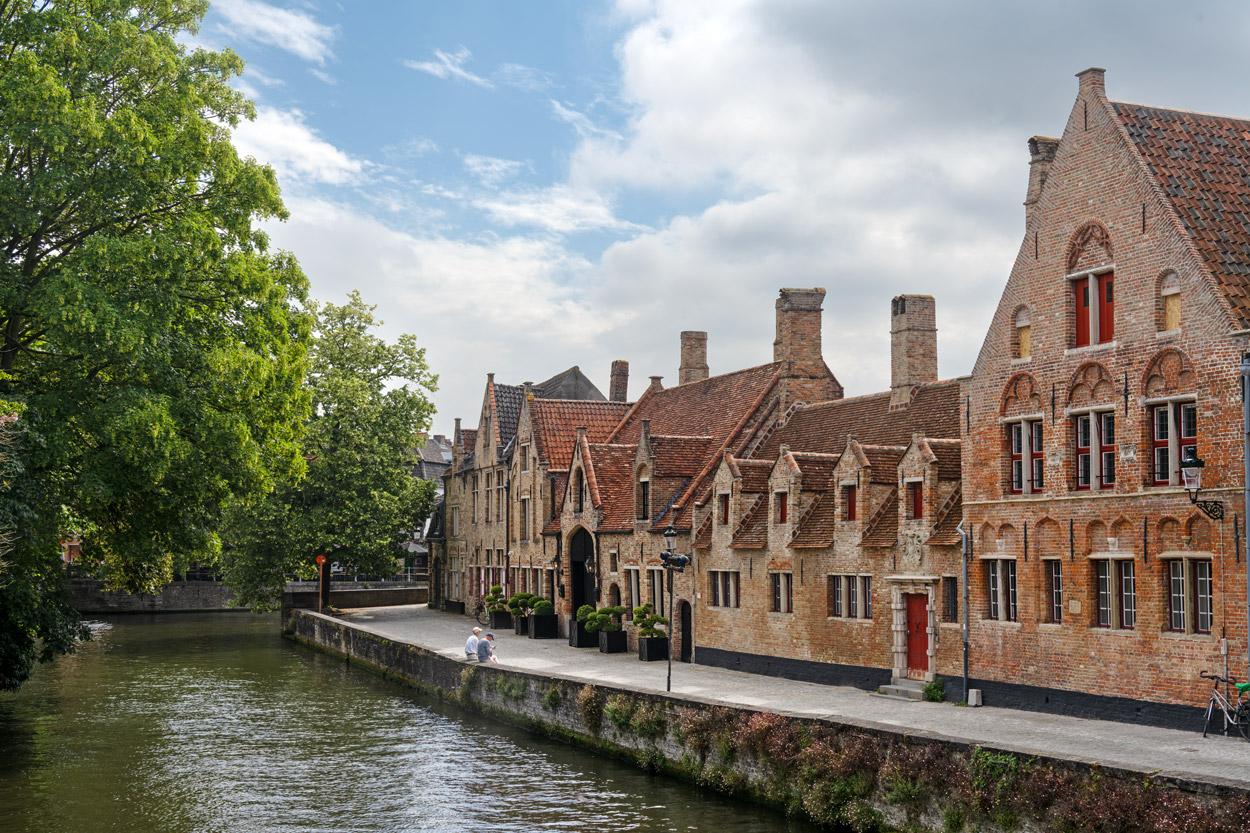
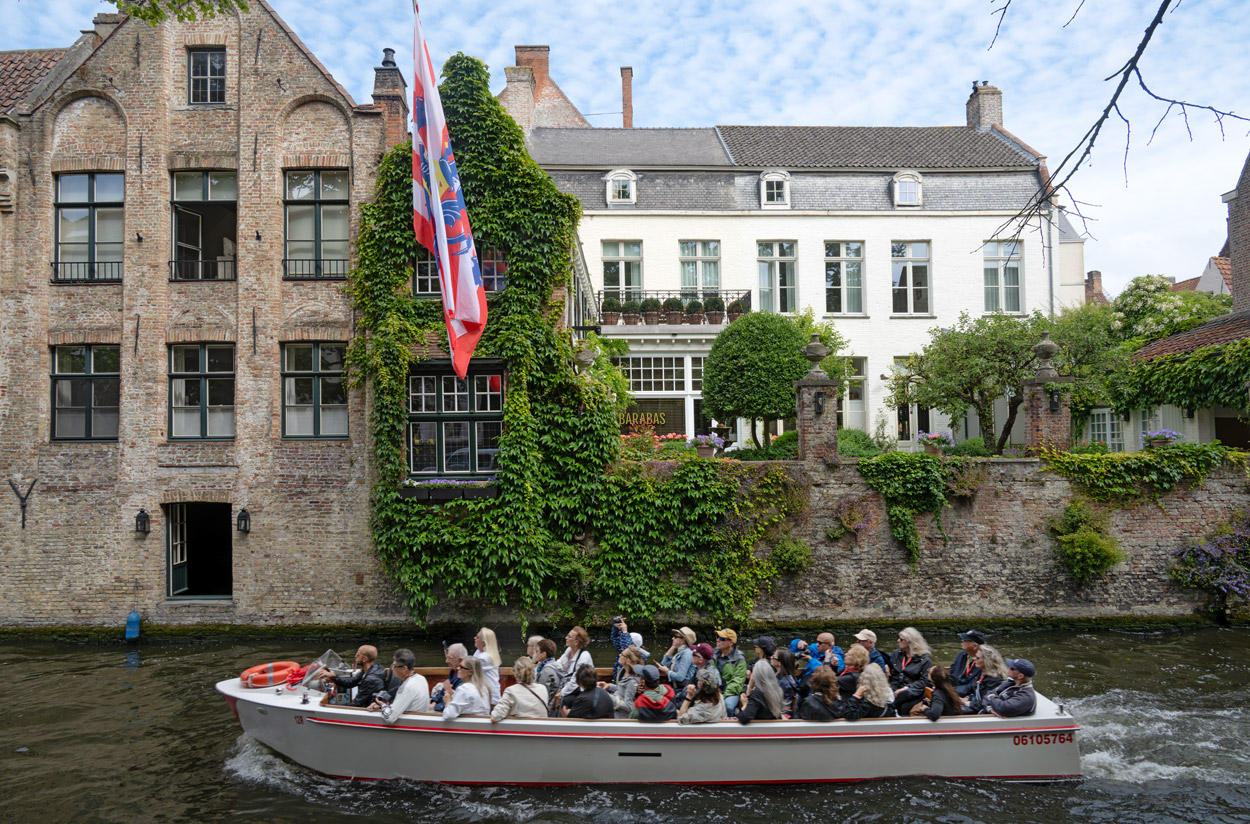
Like Venice and Amsterdam, Bruges has canals that link the old parts of the city together. What role these canals played in the history and development of Bruges, I cannot say. The only activity I saw on the canals were the sightseeing boats that took visitors on water-level tours of the city.
I booked a ticket online to visit Amsterdam’s Rijksmuseum at 9:00 am on 9 June, my first full day in Amsterdam. The museum was a couple of clicks from my hotel along the Singel canal, so I set out around 7:00 to walk on a beautiful Tuesday morning.
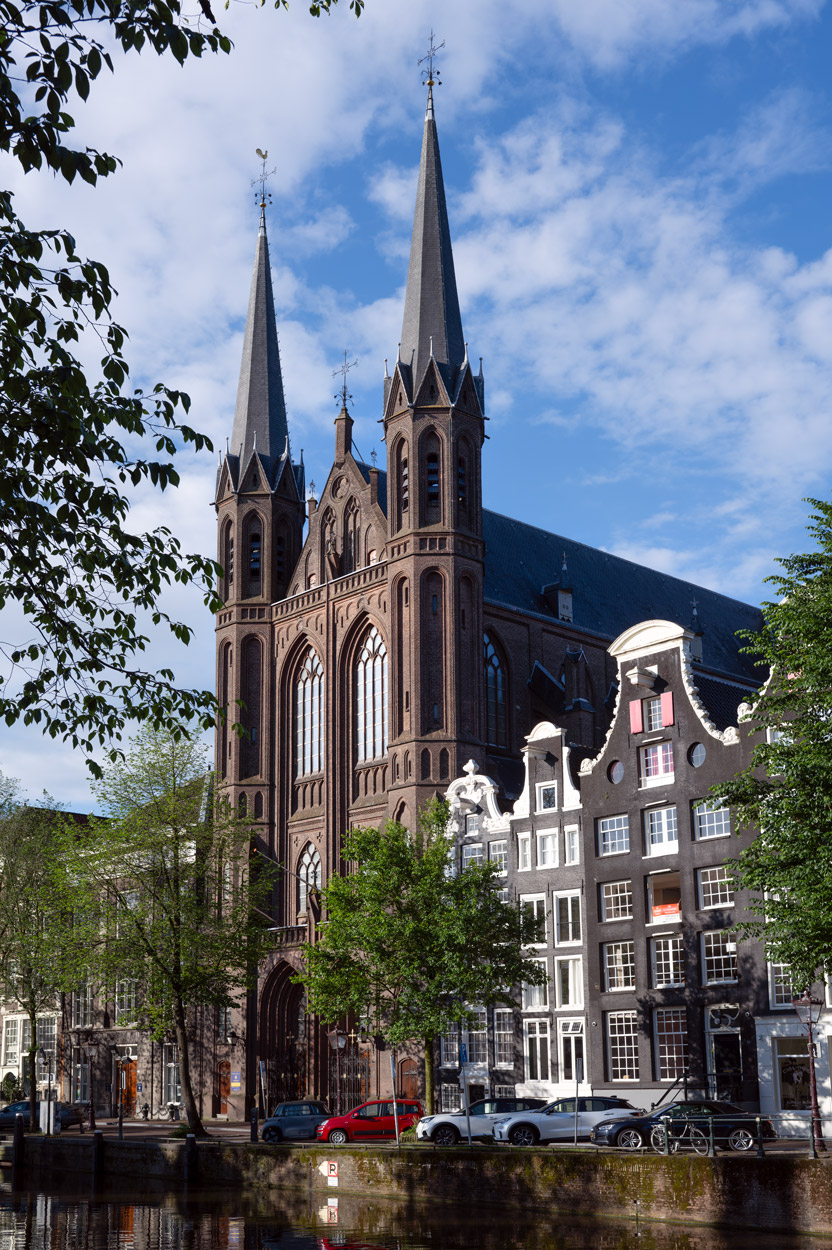
About half way to the museum I was nearing the point where I would turn off the Singel when I came across the Roman Catholic De Krijtberg Church. The Neo-Gothic church with its two towers dominates this stretch of the canal. There has been a church on this site since 1654; the building pictured here, formally named the Church of Saint Francis Xavier, was opened in 1881.
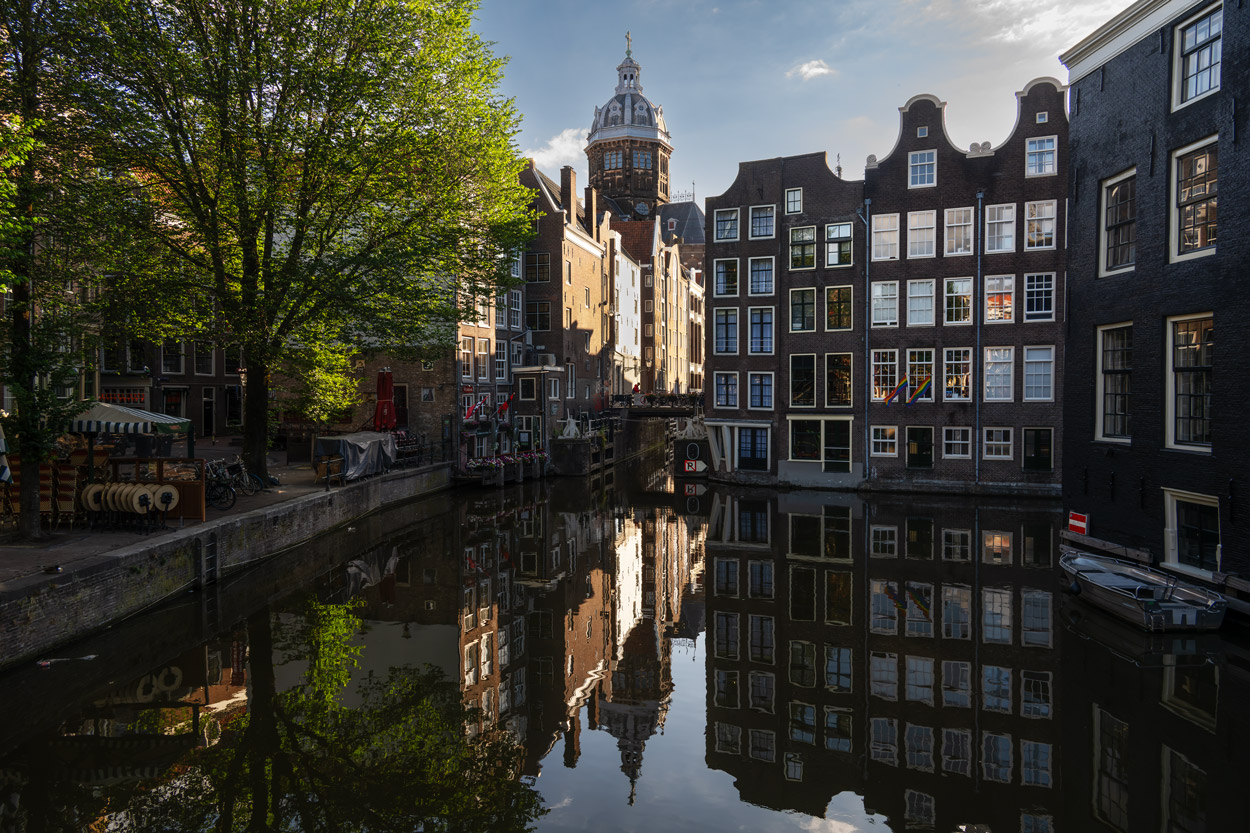
I was at the beginning of a walk that would take me to Amsterdam’s botanical garden and the small but lovely Wertheimpark when I walked into this image. Thinking back, it seems to me the walk had a specific destination, but a month later sitting in Hoi An, I cannot remember what that might have been. The sun was still low in the sky at 7:30 in the morning; the light on the tree and the water literally glowed. The dome of St. Nicholas Church is in the center of the photo. Amsterdam is genuinely a beautiful place.
Though I did not know it at the time, I was standing on the historic Armbrug bridge when I took this photo. The original bridge dates back to 1538; the current bridge, the product of a renovation undertaken in 1988, is not particularly memorable. I happened to run across the history of the bridge when I decided to post the image above and went looking for where I was standing when I took the photo. Not that anyone has asked, but as a point of information, I use an application called Mapy.com when I do map searches online. While Google Maps is better for finding nearby restaurants, unlike Mapy, it had nothing about the Armbrug bridge. In fact when it comes to using a map as a map, Mapy comes out ahead of Google in virtually every respect. Developed and headquartered in the Czech Republic, Mapy has Android and Apple apps, and works fine on my Windows PC. Fed up dealing with criminal organizations like Google? Check out Mapy. And that is today’s unsolicited advertisement.
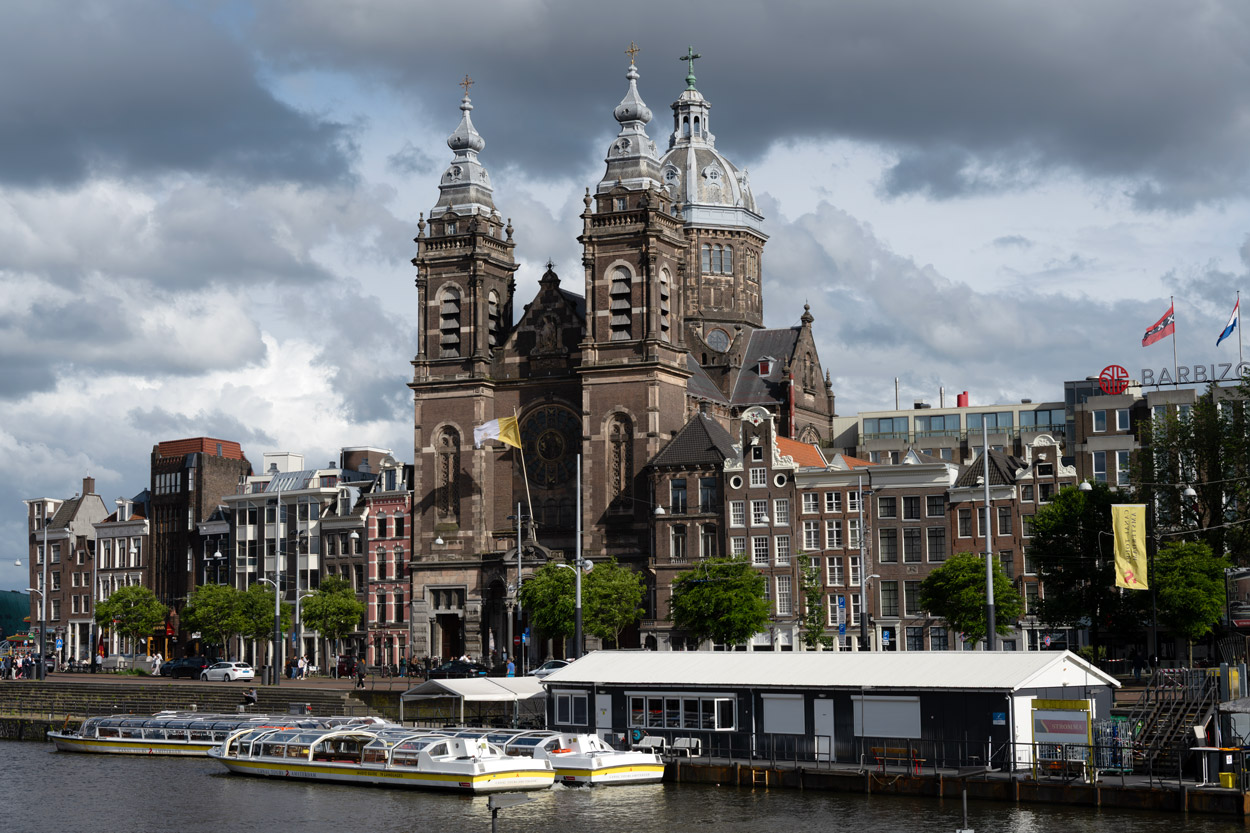
One of Amsterdam’s landmark buildings, the Roman Catholic Church of Saint Nicholas sits across from the city’s central train station in the oldest part of Amsterdam.
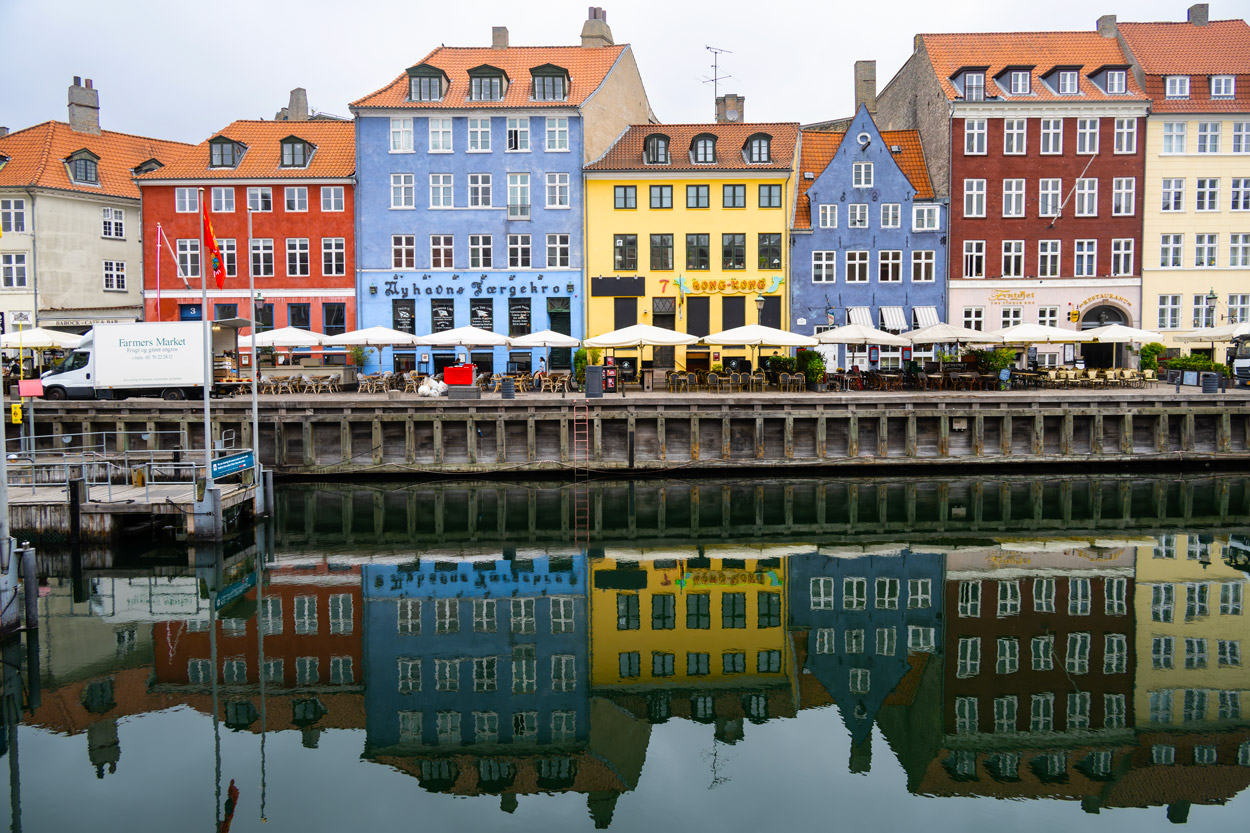
The iconic – or cliche – it’s your choice – photo of Copenhagen invariably shows a row colorful buildings along the Nyhavn. I had always assumed that Nyhvan was a Copenhagen neighborhood featuring a lot of colorful architecture. As usual, on this trip, I did not do enough homework about the places I would visit before showing up at the scene. In fact Nyhvan is a canal commissioned by the Danish King Christian V and completed in 1675. The Nyhvan let ships unload trade goods and fish in Kongens Nytrov (Kings Square), an area at the end of the canal also developed by Christian V, who did a great deal to expand Copenhagen during his reign. In any event, it is only the roughly 300m waterfront of the Nyhvan Canal that is lined with colored buildings and this appears to be the only place such buildings are to be found in Copenhagen.
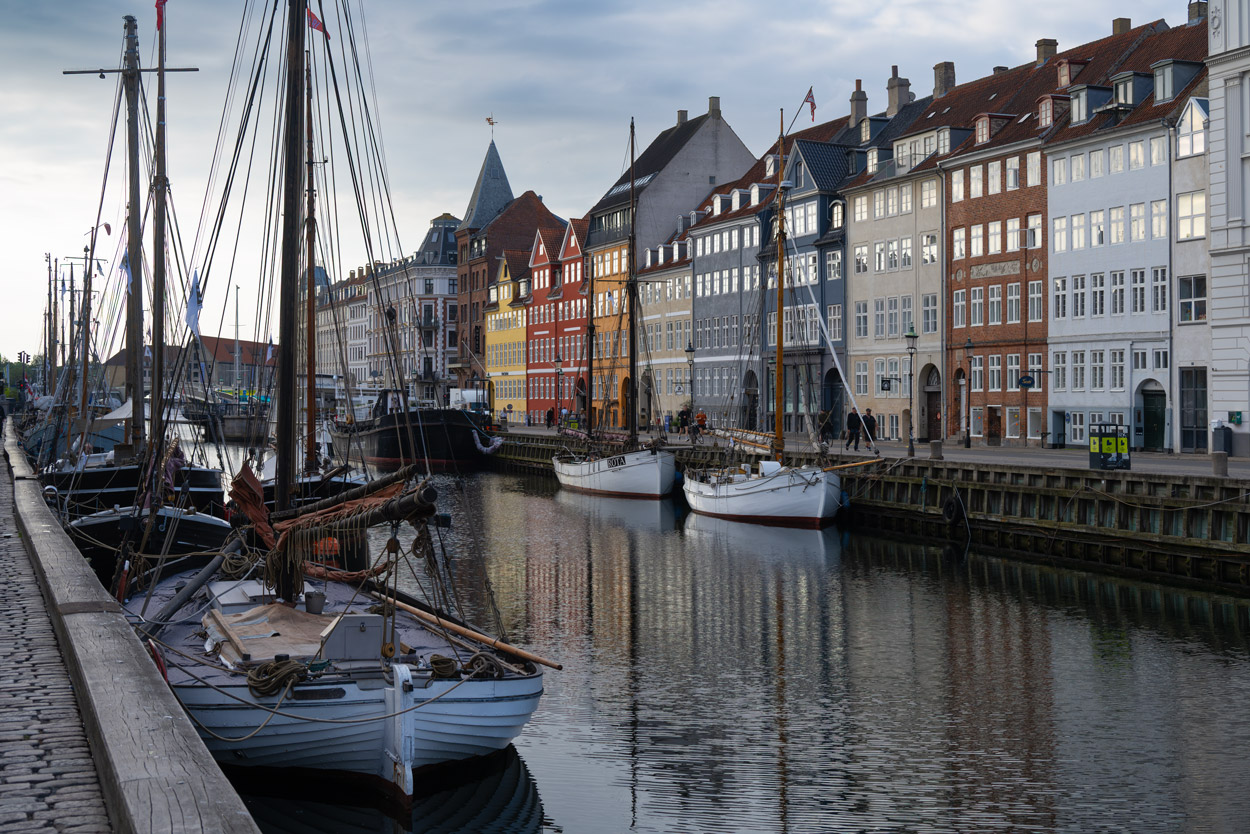
Over time, as ocean-going ships became larger, only smaller ships engaged in local trade came into the canal. By the mid-20th century even this trade had declined and there were no ships visiting Nyhavn. Efforts to revitalize the canal began in the 1960s and 1970s. Today, in addition to traditional buildings of many colors, there are several old sailing vessels moored to the piers along the waterway. The entire Nyhavn canal area serves as a sort of outdoor museum for Copenhagen.
My own Nyhavn colorful buildings cliche photo was taken on a gray, overcast morning; the light was very flat. If I had been paying more attention to content and less to exposure and color in the flat light, I probably would have chosen a group of buildings that did not include a Chinese restaurant. The place seems a little incongruous in a photo that is supposed to be representative of traditional Copenhagen.
I took the photo below with my back to the buildings in the photo above. It shows some of the sailing ships docked in the canal, and gives more sense of the overall look of the Nyhavn area. This was taken on the day after my first visit to Nyhavn. I stopped briefly on my way to another part of Copenhagen to get a photo of the old boats docked along the canal. The morning offered up some hazy sunlight that gives the entire scene a bit of a glow.
Belgium just happens to be on my mind right about now, so I decided to take a break from Denmark and the Danes today.
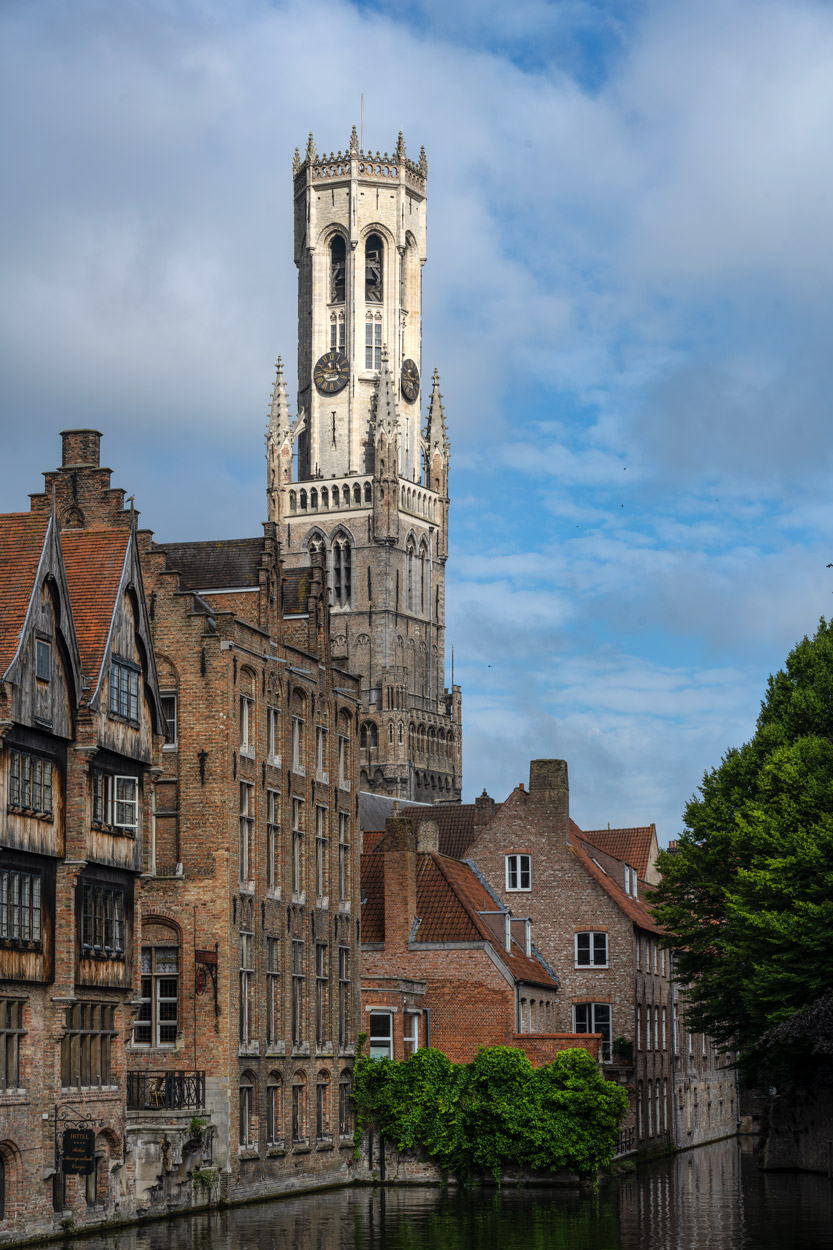
Bruges was the first city in northern Europe visited by merchant vessels from Genoa in the 13th century, becoming the endpoint of seaborne trade going through the Straits of Gibraltar, along the eastern Atlantic coastline, and through the English Channel to the low countries in the north. Today much of the center of old Bruges is a beautifully preserved UNESCO World Heritage site drawing tourists from all over Europe. The Belfry, visible from everywhere in the old city, stands in the Grote Markt in the center of Bruges.
As for Belgium being on my mind, I just finished watching that country’s national team defeat the US team 4 to 1 in a World Cup football match. While I sympathize with the US players who now have to come to terms with being beaten and knocked out of the World Cup competition, I can’t say I am put out or upset that the US lost. Given the performance of the garbage representing our country right now, the US does not deserve to win any accolades these days. It is as simple as that.
Belgium moves on to a Quarterfinal match with Spain on 11 July.
Ponte dei Sospiri or the Bridge of Sighs spans the Rio Del Palazzo, which runs along the side of the Doge’s Palace and St. Mark’s Square. After appearing in court in the Doge’s Palace, convicted prisoners were taken across this bridge to a prison on the other side. As they got their last view of beautiful Venice crossing the bridge, prisoners were known to sigh; hence the name of the bridge. Or so the story goes.