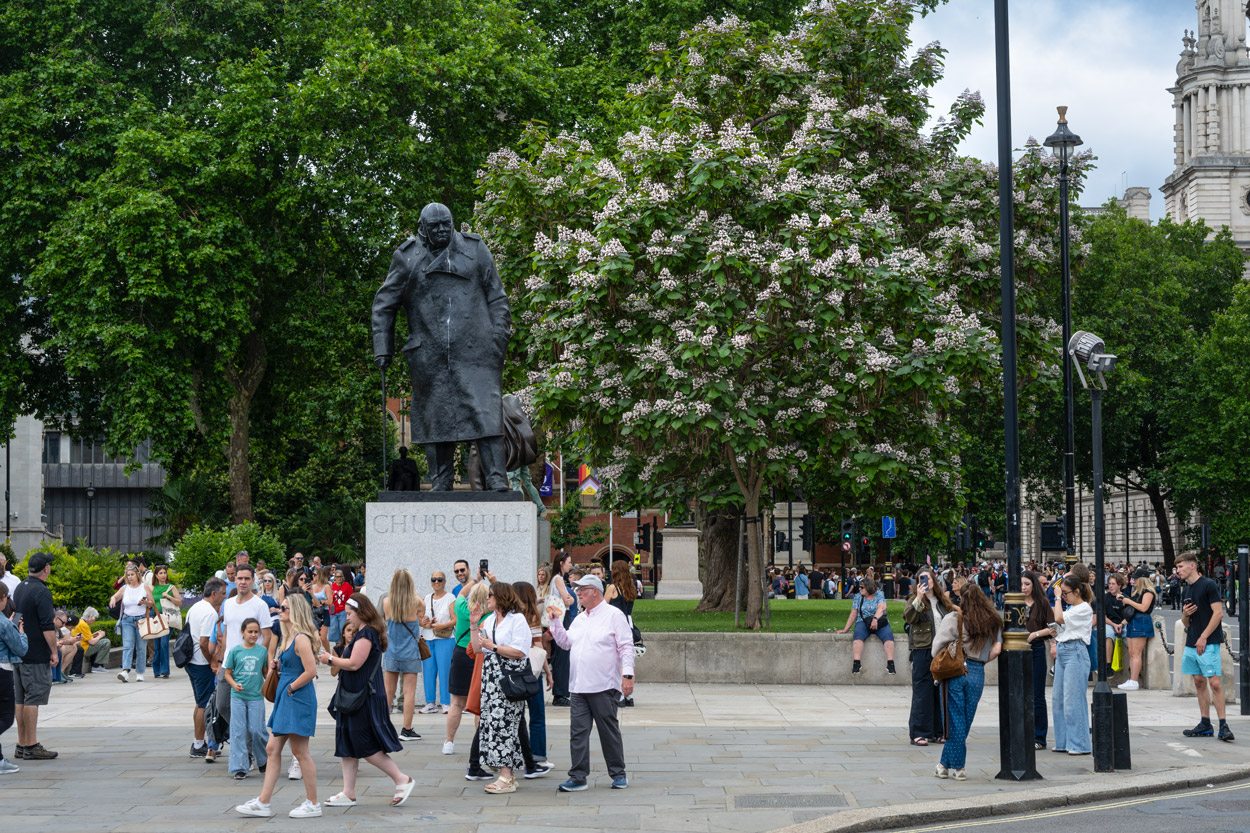
Poor Winston, England’s WWII savior, has pigeon shit covering his head and running down his overcoat while tourists are busy smiling and posing next to his statue in London’s Parliament Square. Of course, there are those who might say that the die hard defender of a moribund, collapsing empire is getting just what he deserves from the pigeons. And I admit that I am inclined to agree with that sentiment.
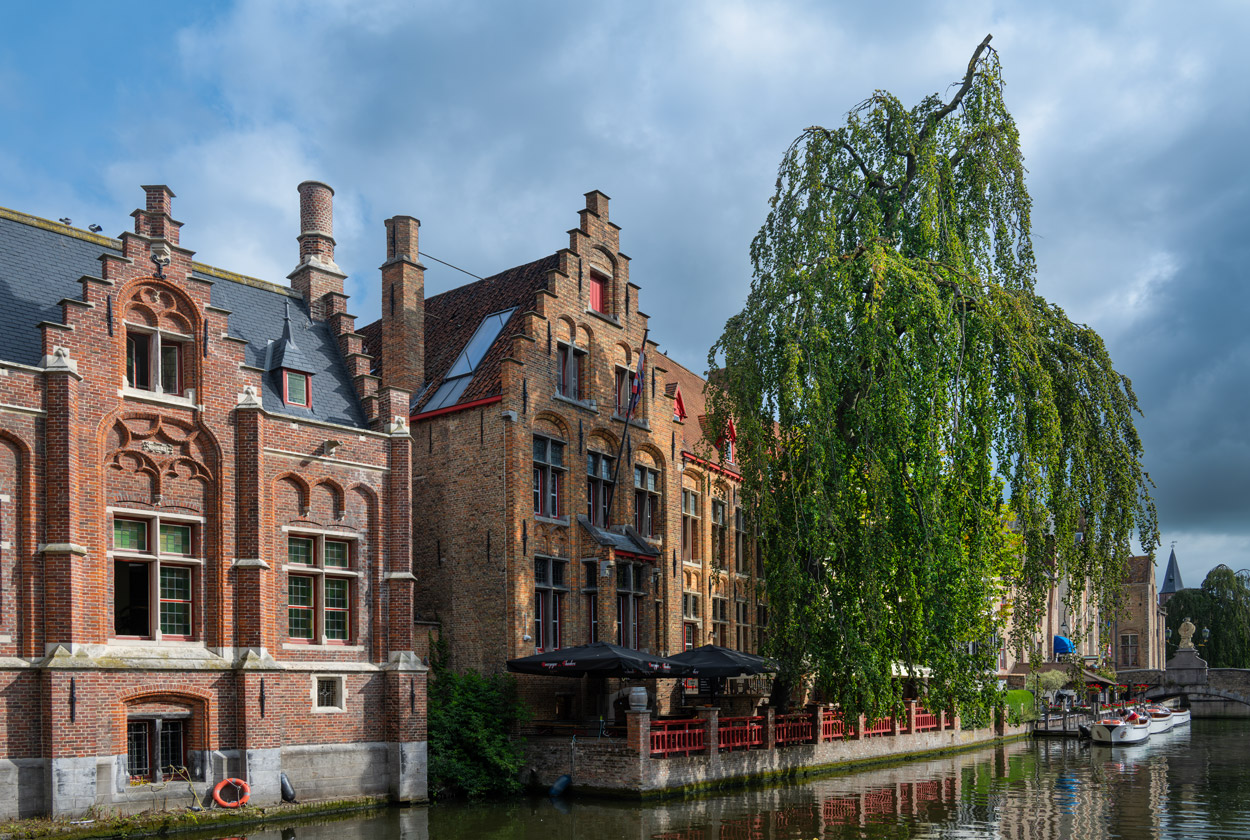
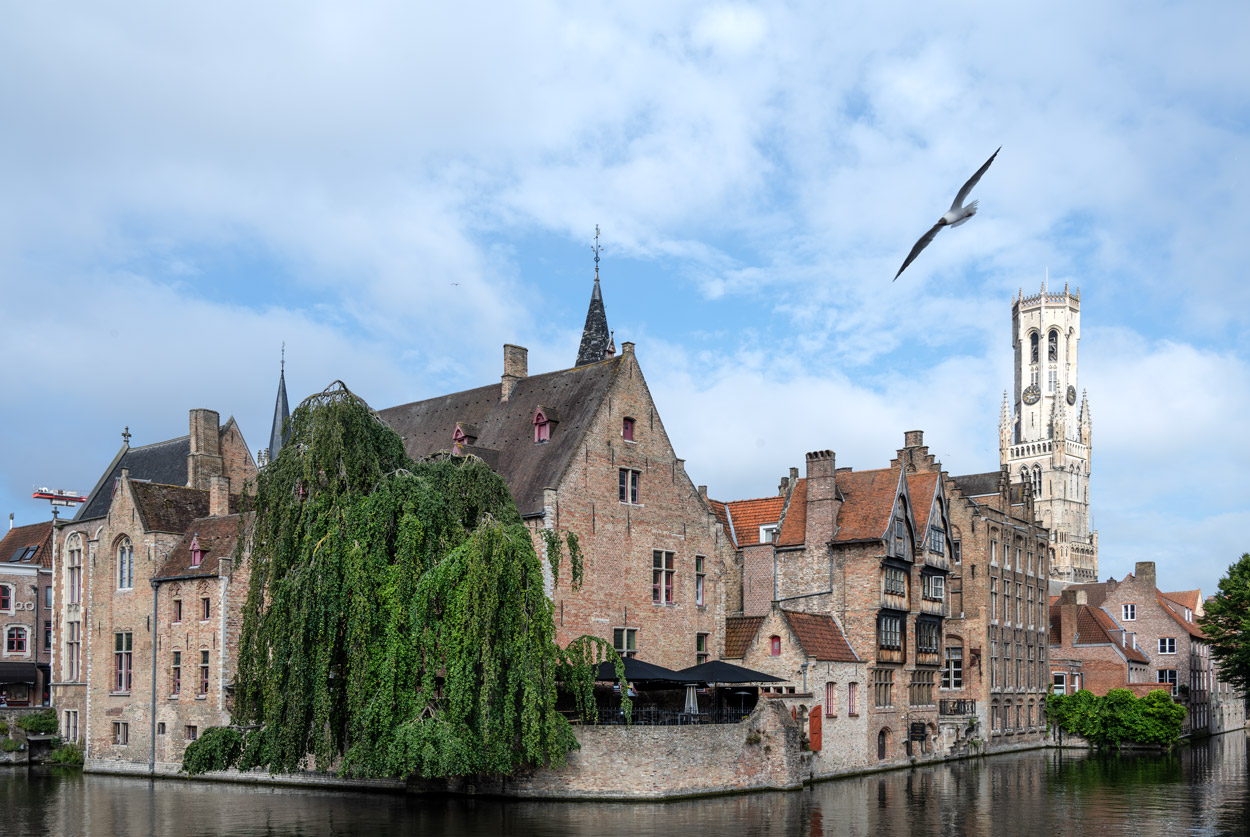
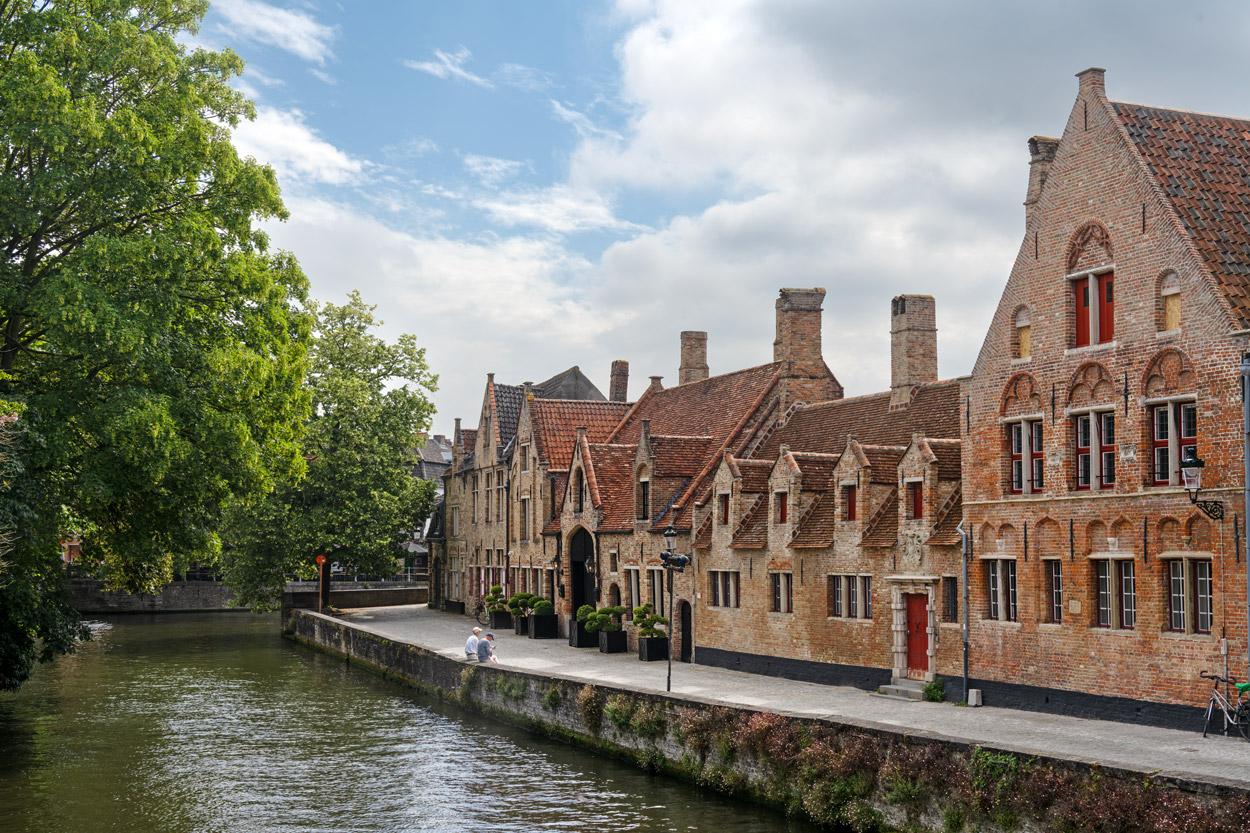
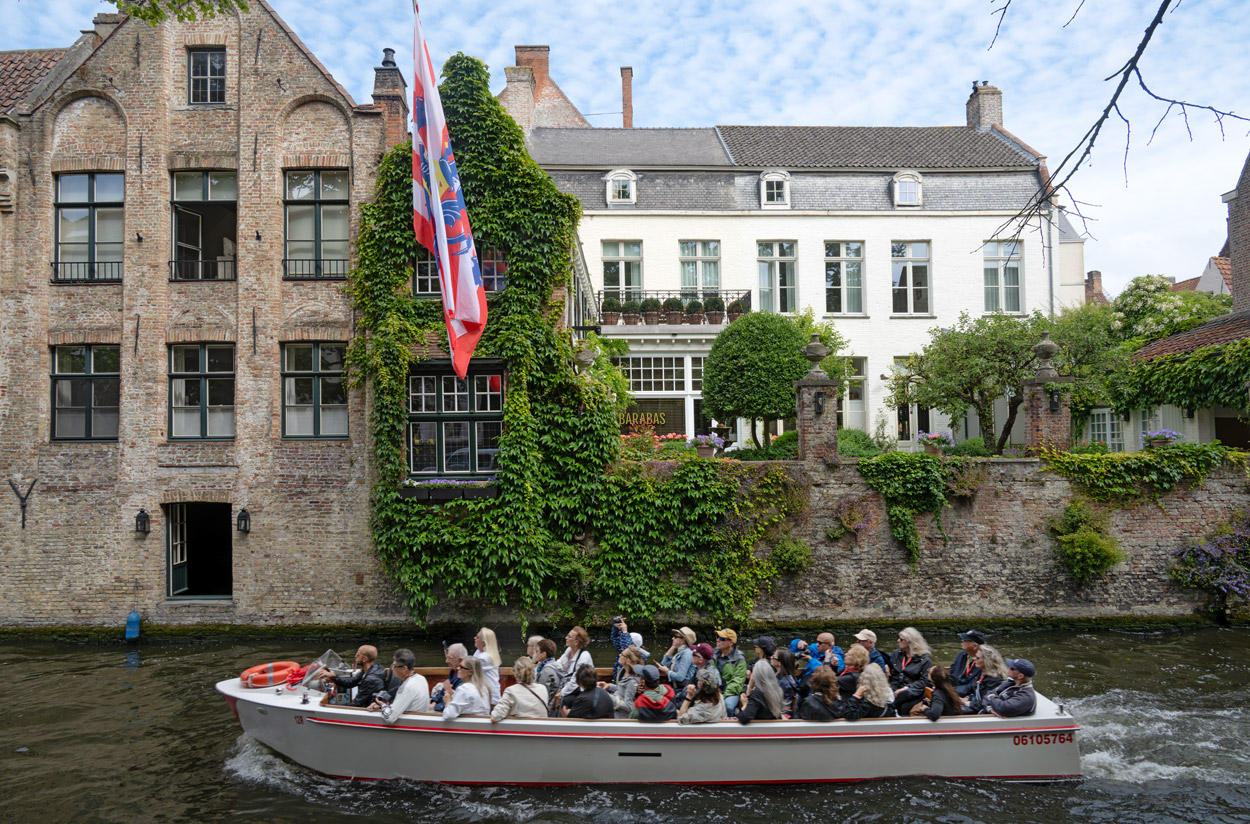
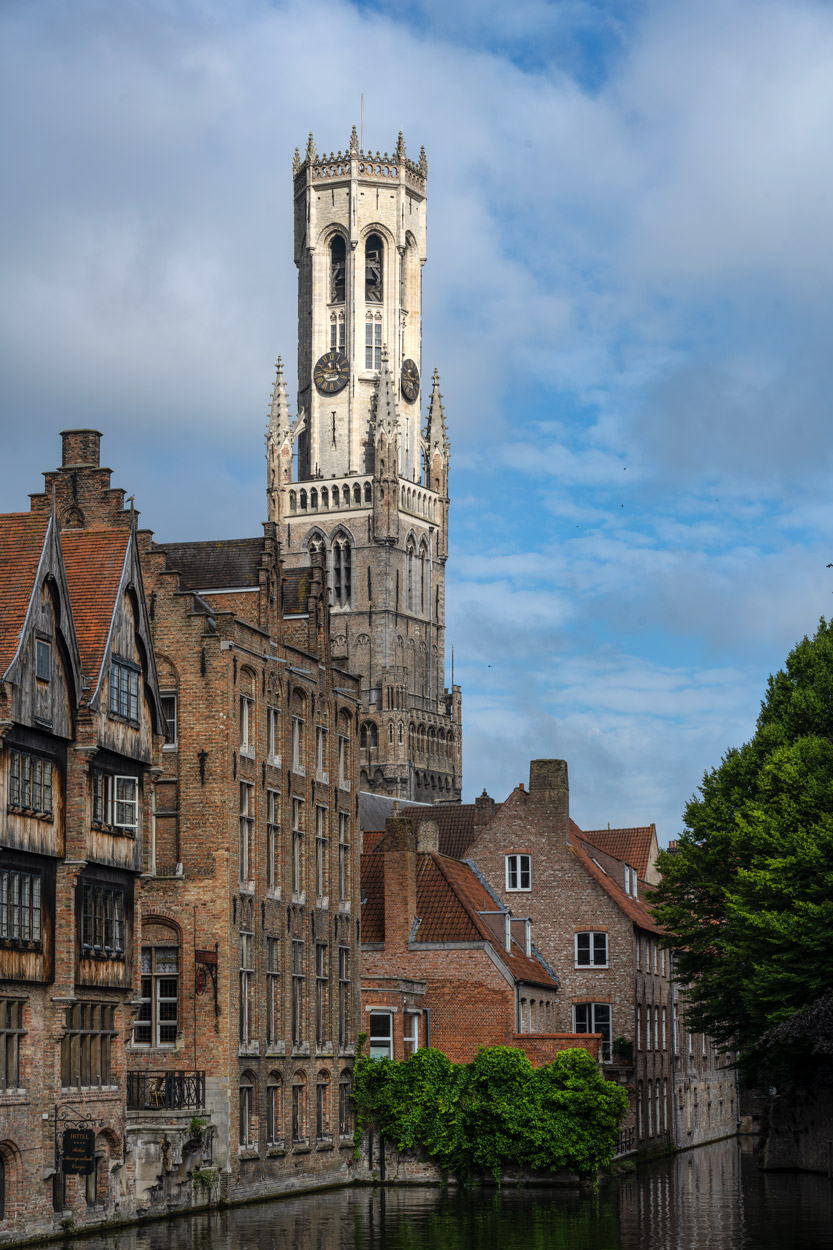
Like Venice and Amsterdam, Bruges has canals that link the old parts of the city together. What role these canals played in the history and development of Bruges, I cannot say. The only activity I saw on the canals were the sightseeing boats that took visitors on water-level tours of the city.
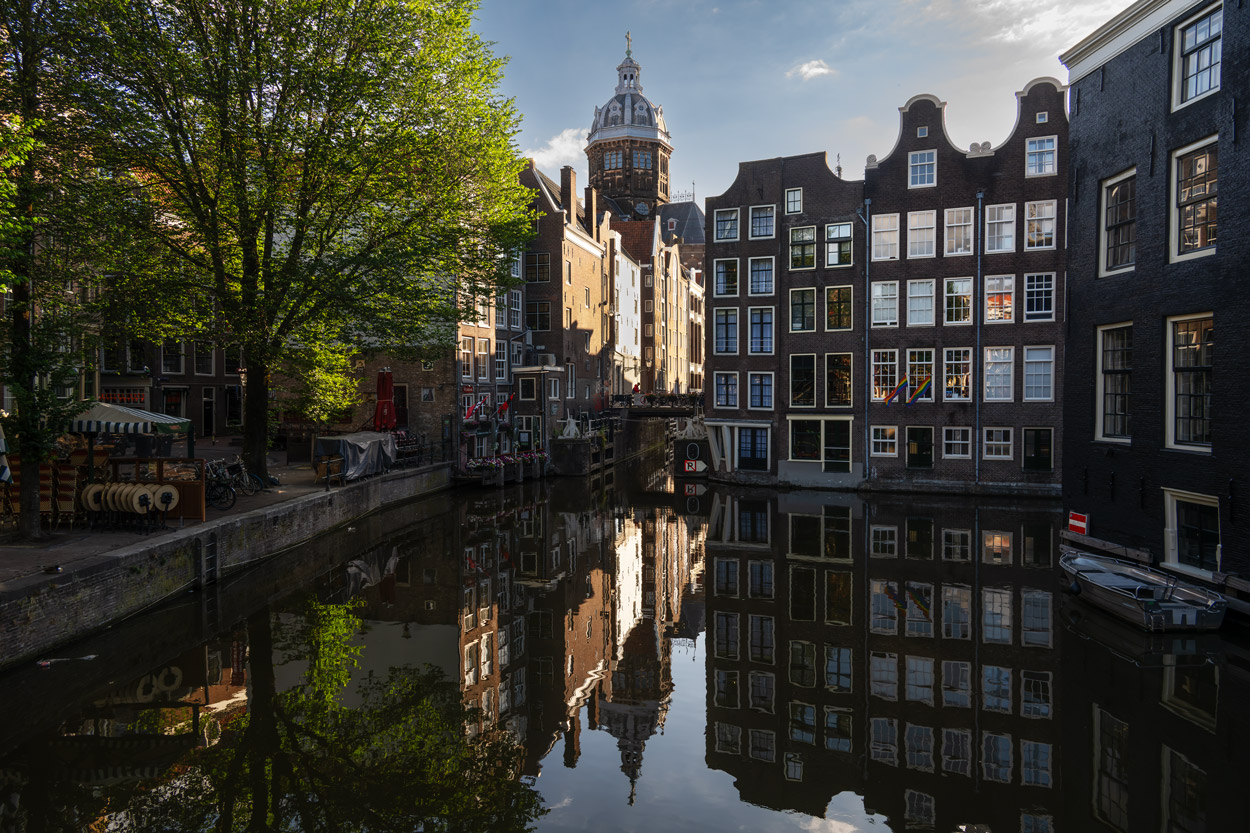
I was at the beginning of a walk that would take me to Amsterdam’s botanical garden and the small but lovely Wertheimpark when I walked into this image. Thinking back, it seems to me the walk had a specific destination, but a month later sitting in Hoi An, I cannot remember what that might have been. The sun was still low in the sky at 7:30 in the morning; the light on the tree and the water literally glowed. The dome of St. Nicholas Church is in the center of the photo. Amsterdam is genuinely a beautiful place.
Though I did not know it at the time, I was standing on the historic Armbrug bridge when I took this photo. The original bridge dates back to 1538; the current bridge, the product of a renovation undertaken in 1988, is not particularly memorable. I happened to run across the history of the bridge when I decided to post the image above and went looking for where I was standing when I took the photo. Not that anyone has asked, but as a point of information, I use an application called Mapy.com when I do map searches online. While Google Maps is better for finding nearby restaurants, unlike Mapy, it had nothing about the Armbrug bridge. In fact when it comes to using a map as a map, Mapy comes out ahead of Google in virtually every respect. Developed and headquartered in the Czech Republic, Mapy has Android and Apple apps, and works fine on my Windows PC. Fed up dealing with criminal organizations like Google? Check out Mapy. And that is today’s unsolicited advertisement.
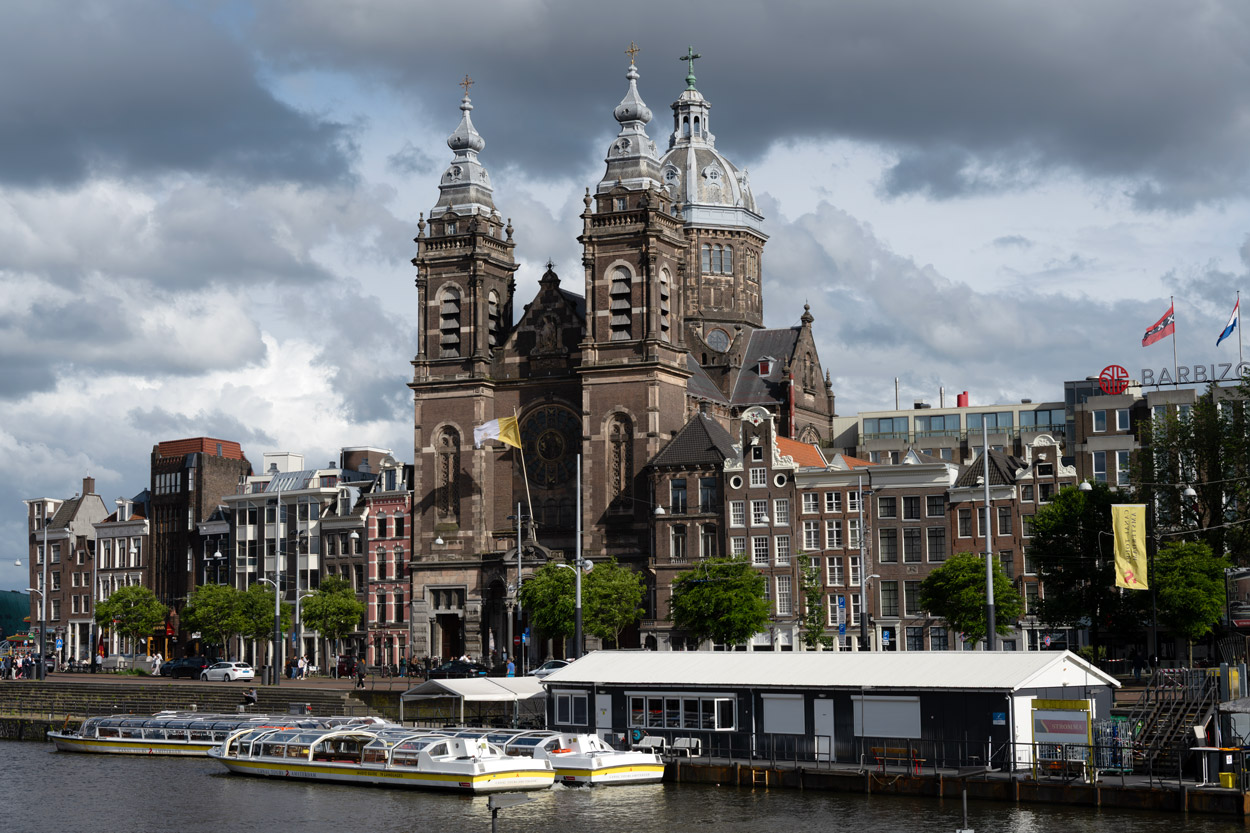
One of Amsterdam’s landmark buildings, the Roman Catholic Church of Saint Nicholas sits across from the city’s central train station in the oldest part of Amsterdam.
Belgium just happens to be on my mind right about now, so I decided to take a break from Denmark and the Danes today.
Bruges was the first city in northern Europe visited by merchant vessels from Genoa in the 13th century, becoming the endpoint of seaborne trade going through the Straits of Gibraltar, along the eastern Atlantic coastline, and through the English Channel to the low countries in the north. Today much of the center of old Bruges is a beautifully preserved UNESCO World Heritage site drawing tourists from all over Europe. The Belfry, visible from everywhere in the old city, stands in the Grote Markt in the center of Bruges.
As for Belgium being on my mind, I just finished watching that country’s national team defeat the US team 4 to 1 in a World Cup football match. While I sympathize with the US players who now have to come to terms with being beaten and knocked out of the World Cup competition, I can’t say I am put out or upset that the US lost. Given the performance of the garbage representing our country right now, the US does not deserve to win any accolades these days. It is as simple as that.
Belgium moves on to a Quarterfinal match with Spain on 11 July.
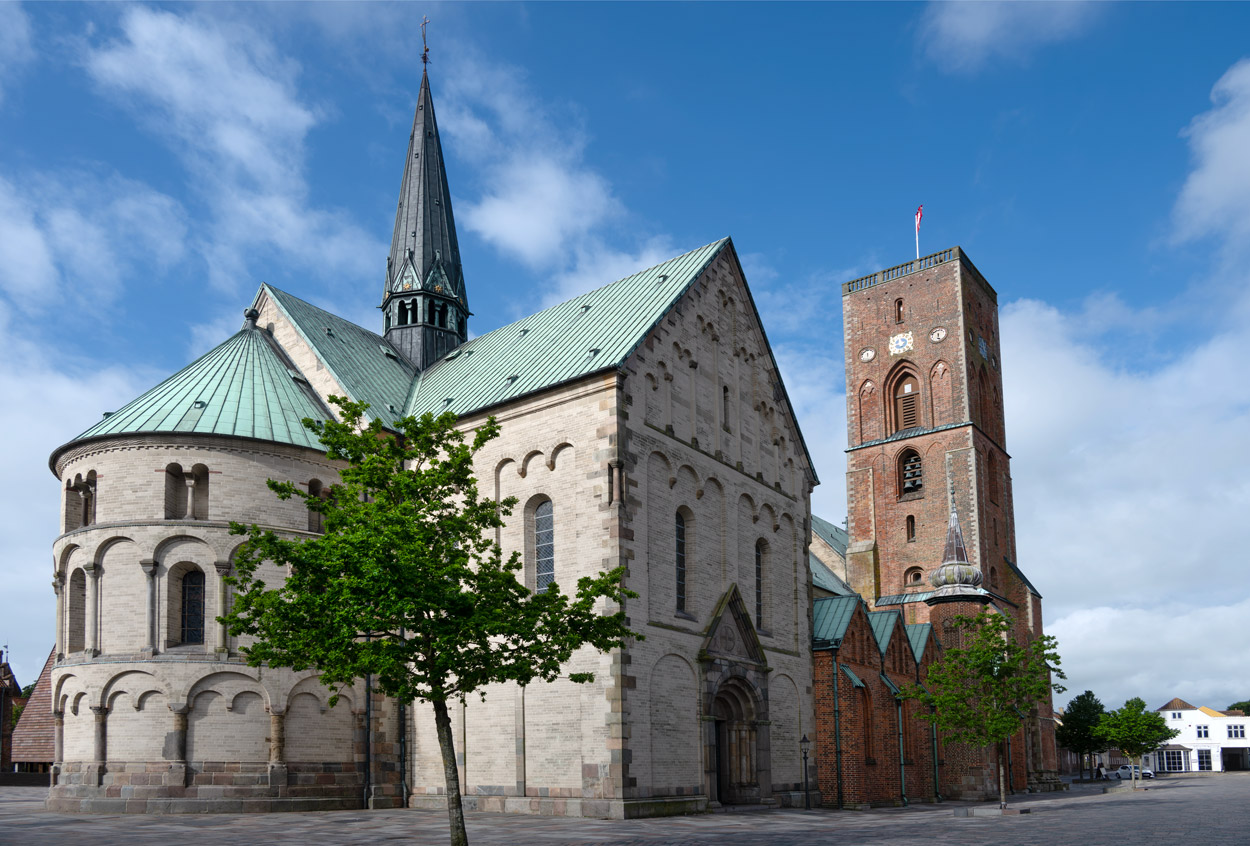
A number of online travel guides bill Ribe, a town on Denmark’s west coast with a few more than 8000 inhabitants, as Denmark’s oldest town. This is very likely the case as Ribe was already a center of commerce and trade early in the 8th century during the age of the Vikings, and people have lived in the village continuously since then.
With its beautifully preserved and restored buildings in a quiet village setting, today Ribe is a popular tourist destination for Danes, Germans, and other Europeans. The Ribe Cathedral sits at the center of the old town square and dominates its surroundings. The first church in Ribe, built of wood, was founded in 860 and apparently at that time a community of Christians lived together in Ribe with the pagan Vikings. The first stone church on the site was completed in the 12th century. Begun as a Roman Catholic church, today the cathedral is part of the Church of Denmark, which I think is a flavor of the Lutheran denomination. If Wikipedia is any guide, the history of the cathedral, from inception to today, is a tale of sectarian strife, conflict, and mayhem, the bread and butter of religion as far as I am concerned, accompanied by fires and other natural disasters.
Be that as it may, I readily admit that I am fascinated with church architecture. The amount of thought, creative energy, devotion, and monumentally difficult labor that went into building and adorning ancient and medieval churches is downright astonishing.
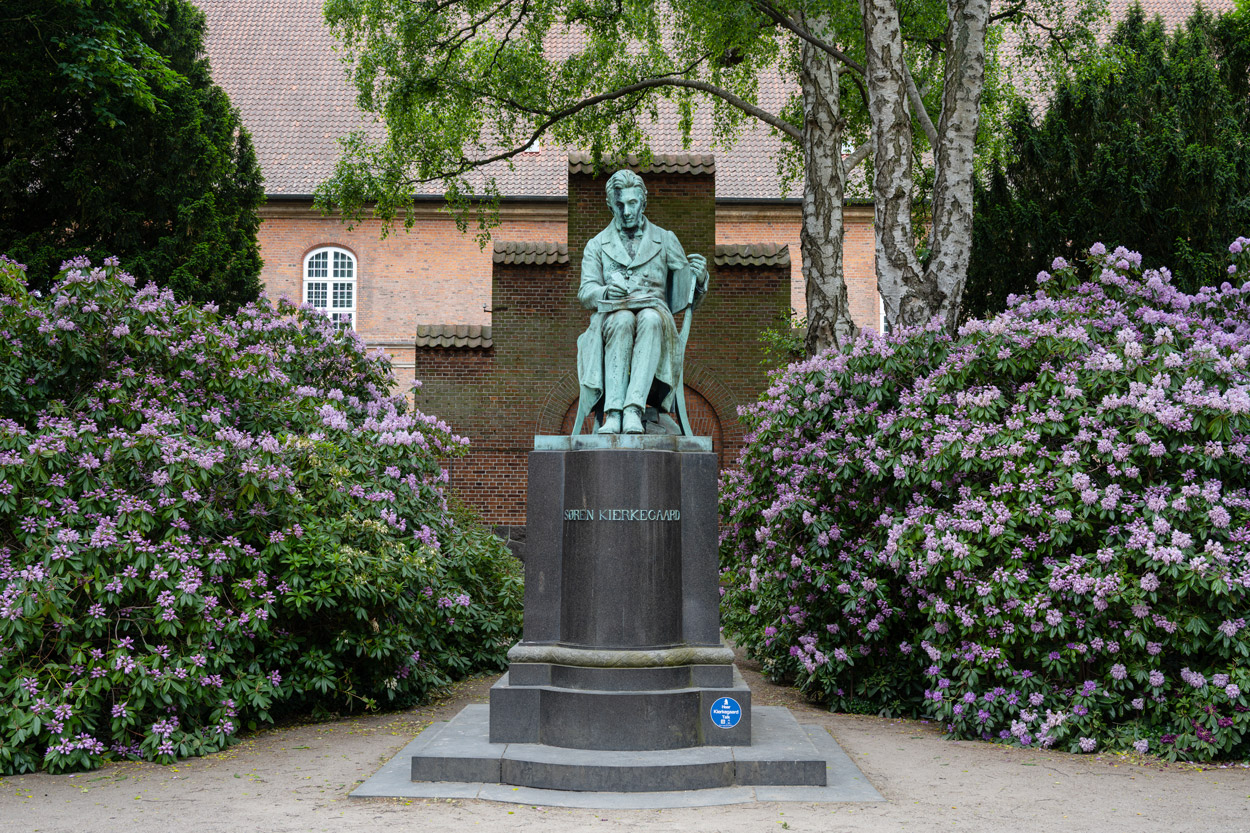
Søren Kierkegaard. Words like philosopher and theologian came to mind when I saw this statue in Copenhagen’s beautiful Royal Library Garden. I read the first paragraph of Kierkegaard’s Wikipedia entry. This told me the man was a prolific thinker writing about a wide range of topics – I did not read the lengthy article introducing his works – and is considered to have been the first existentialist philosopher. His was a name my dad dropped from time to time during his years at Harvard in the early 1960s, and that is most likely when I first heard of Kierkegaard.
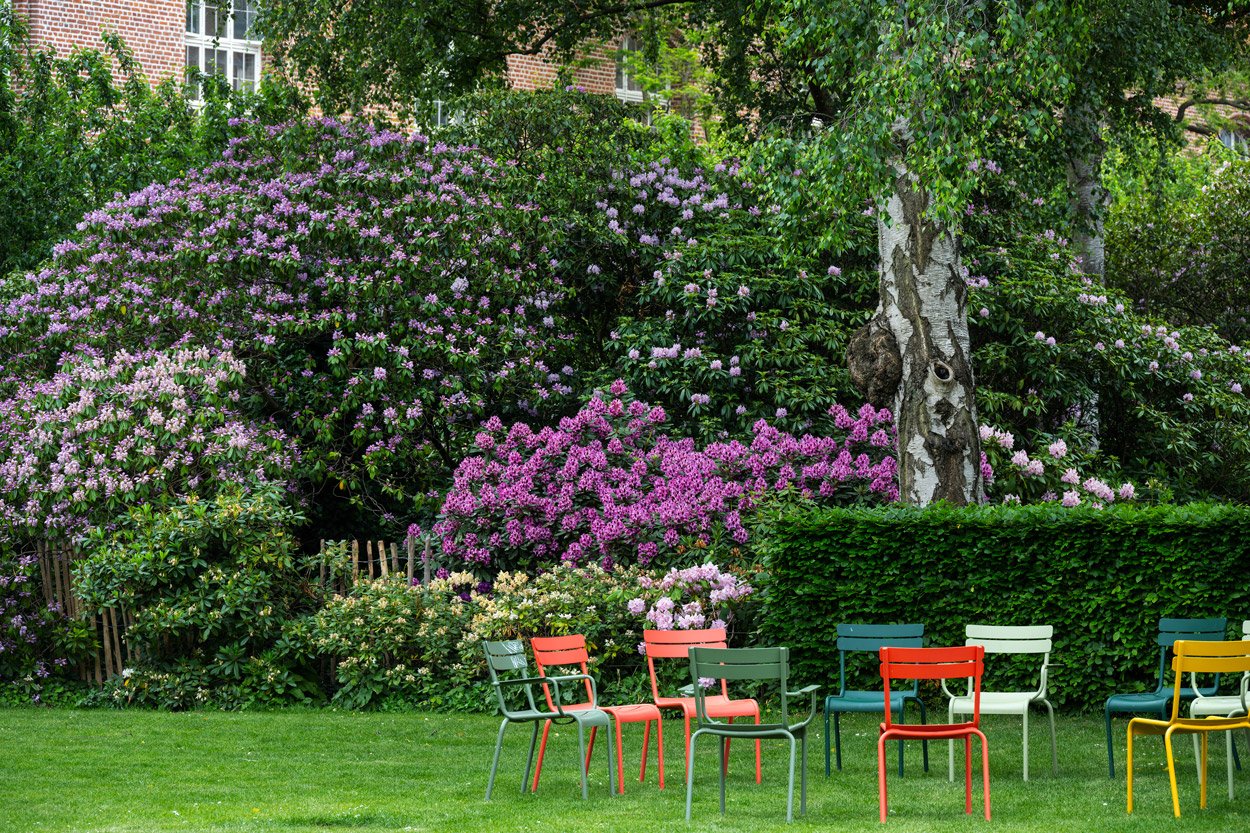
The Royal Library Garden is a quiet, restful place, and I had been sitting on a bench near Kierkegaard for quite some time when a group of Chinese tourists walked into the area around the statue. They immediately began standing in front of Kierkegaard and posing for photos with hands raised in V salutes. I amused myself wondering how many, if any, of these Chinese had ever heard of Kierkegaard or knew anything of his work. Of course, it is very possible most of them knew more than I did. Be that as it may, I wanted to get a picture of this photo taking, but doing so would have required me to get in the face of some of the group. I was not inclined to do that and remained sitting on my bench.
Originally, Copenhagen was to be the European starting point of a trip to Iceland I was planning for late summer in 2025. When, in the spring of 2025, Minh and I decided to buy a parcel of land and build a house, that trip was put on hold. In February 2026 the house was finally – well, mostly – finished and we were able to move in.
At that point I got back to trip planning. First, although it had been the center of my earlier travel idea, I scratched Iceland from my itinerary. I decided that renting a car and driving solo around the island, stopping to see scenic wonders along the way, might be a bit too much to handle for my going-on 77 years old physical equipment. As much as it annoys me to acknowledge this, I am simply not as physically capable today as I was even 10 years ago.
I am, however, still capable of travel somewhat less strenuous than a solo drive around Iceland.
Instead of a way point on a journey to Iceland, Copenhagen became the starting point of a European trip that, in addition to Denmark, included visits to Netherlands, Belgium and the UK. The fact that Vietnam Airlines introduced a direct flight from Ho Chi Minh City to Copenhagen sometime in 2025 encouraged me to keep Copenhagen on my itinerary. Although Denmark had never been on my Europe must-see list, I decided it would be an interesting place to begin my travels.
After the long haul from Vietnam, I arrived at Copenhagen Airport on 30 May 2026 at 07:30 in the morning. Fitful sleep is the best I ever manage on long distance flights, and I did not even achieve that level of “rest” on this particular flight. So I was especially fuzzy around the edges as I emerged from the plane. I was relieved that the pleasant looking, graying women at the Passport Control window did not become frigid when I handed her a US passport. Not that A Dane would have any reason to be fed up with Americans. Right? Whatever, entry to the Schengen Area took no more than a couple of minutes (and as I write this I cannot help but think of the hour it took to make my way in a massive line through Passport Control in Hanoi when I returned to Vietnam a couple of days ago). Unfortunately, entering the Schengen Area no longer results in a physical stamp in one’s passport – it is all a digital transaction with data encoded in the passport entered into a computerized database. Nowadays it is virtually impossible to fill up a passport with the visas and entry-exit stamps that document travels. My old passports have become a sort of collector’s item.
When I emerged into the airport, I was struck by the fact that the arrivals area was relatively small, far removed from the cavernous terminals that are so common in airports today. And there was no information kiosk. Virtually all airport services were automated – it was difficult to find anybody to give me information about anything. I did find an ATM from which I hoped to draw around $100 worth of Danish Krone. Alas, muddled as I was, I was mistaken about the exchange rate and drew DKK 5,000 thinking that would cost me USD 80 or 90. Wrong. The transaction cost me almost USD 800. Suffice it to say, I had no shortage of cash during my 8 days in Denmark.
Purchasing a metro ticket that would get me into the city of Copenhagen required the use of a ticket machine with instructions that I found impenetrable. Maybe if I had slept more on the plane… Eventually, I spied two Metro employees standing near the ticket machines – an impromptu information kiosk? – and one of them helped me buy a ticket. He worked so quickly that I had on idea what he did and had to start over the next time I wanted to ride the Metro. On the good news front, the train I boarded at the airport ran directly to the stop for my hotel; I did not need to change trains.
I arrived at the hotel well ahead of the 14:00 check-in time, so I ended up walking around the neighborhood for a couple of hours while the hotel worked on making up rooms. First impressions: Copenhagen – at least the area in which I found myself – was quiet, uncrowded, and affluent. It was a rather blustery, cool, overcast day, not raining, but hardly very welcoming to a tired, first-time visitor. There were several small (man made?) lakes near the hotel and the paths around these were crowded with joggers and bicyclists. Young, svelte, fit looking, Nordic type joggers for the most part. Lots of blond hair. I cannot remember ever seeing so many people out jogging in a reasonably small area. I eventually walked in to a place to get some lunch, lots of whole grains, vegetables and nuts on the menu, and found the place took only cards. Not encouraging, considering my recent ATM misadventure. I ate something that was tasty and, no doubt, good for me before heading back to my hotel where I finally got into my room and a rest at around 12 noon.
To be continued…
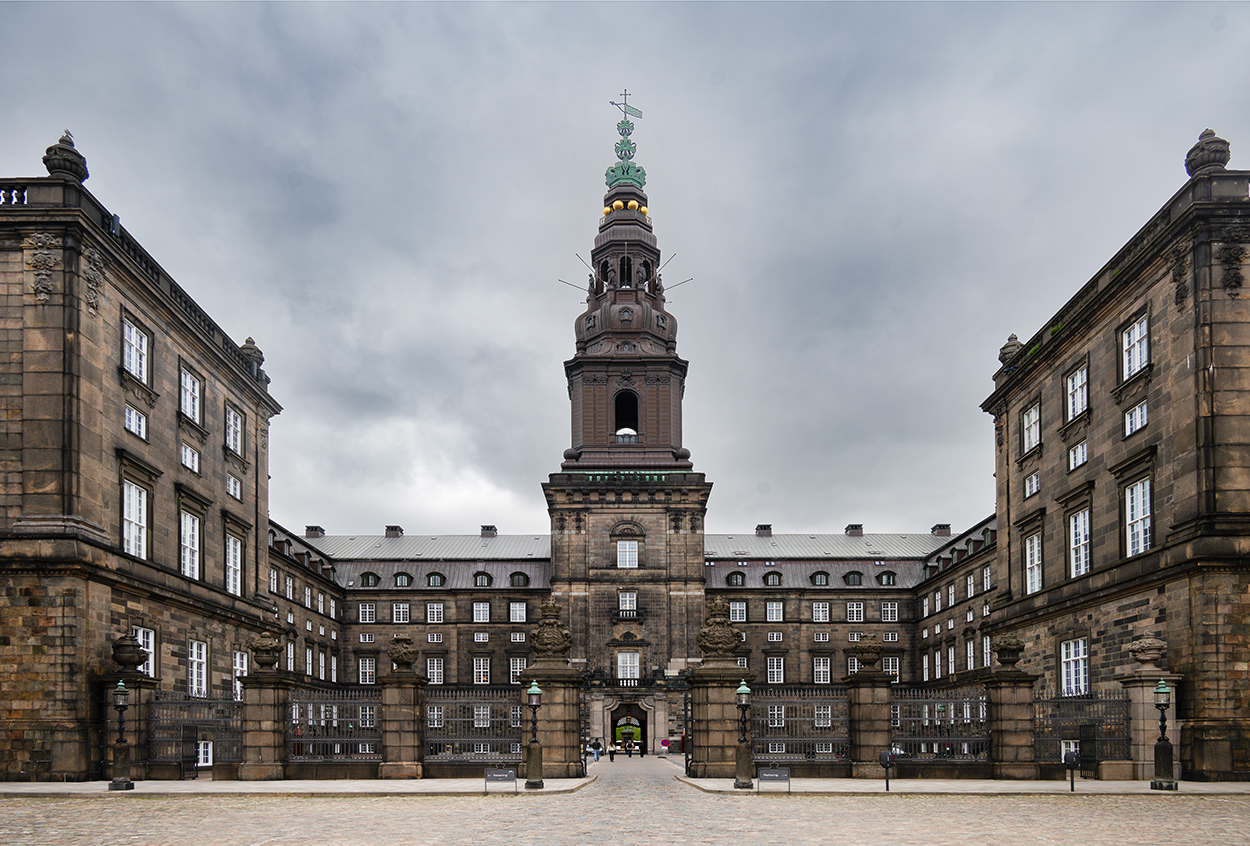
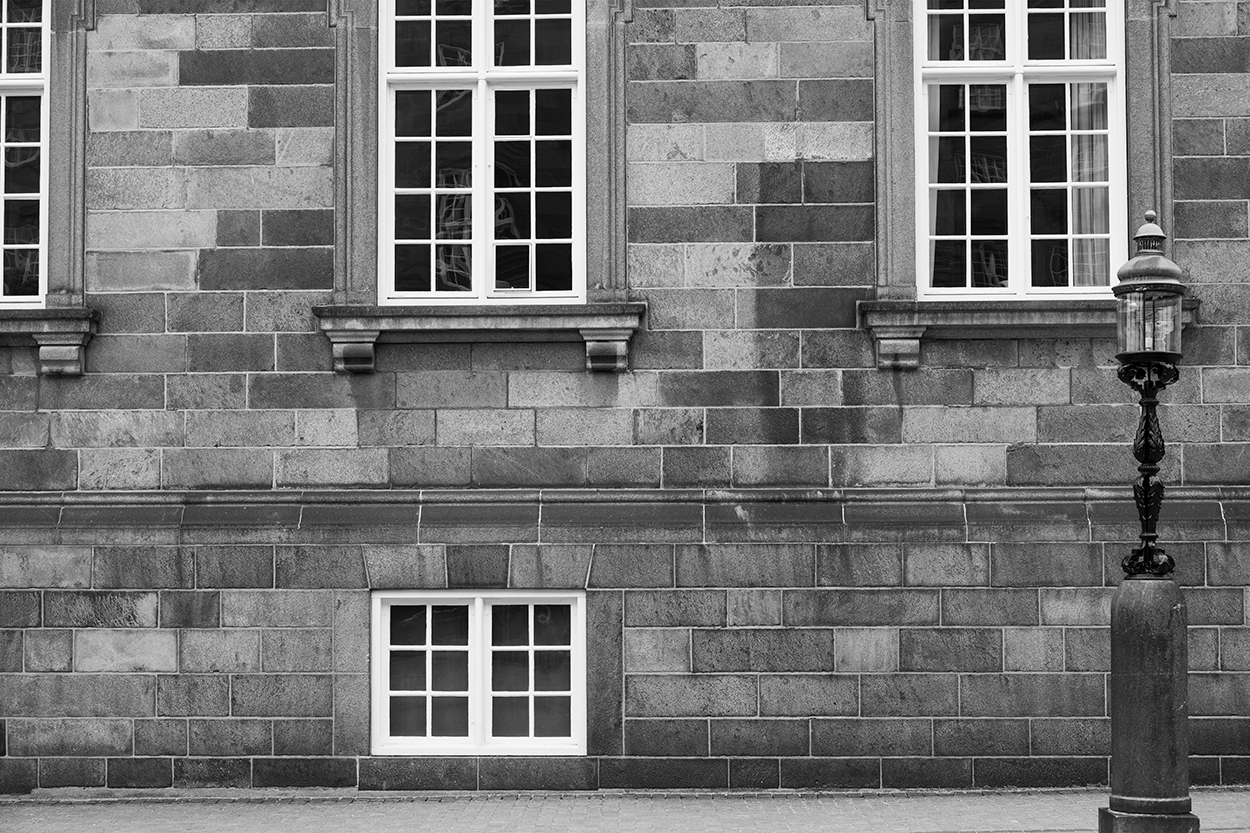
The Christiansborg Palace pictured here is the third iteration of a building of this name on this site. The previous two palaces, the first of which was completed in 1745, were destroyed by fire. The palace pictured here was completed in 1928, and in the process of excavations for the building, buried ruins of castles from as early as the 13th century were discovered. The Palace was intended to be the home of Denmark’s monarch, though it seems the royal family has never resided in this building. Today, Christiansborg Palace houses all three branches of Denmark’s government: the Prime Minister’s office, the Danish Parliament, and the country’s Supreme Court.
Meiji Jingu Ichino Torii is pictured here. Gates like this are called torii and are found throughout Japan at the entrances and within Shinto shrines. As entrance ways, torii mark the spot where visitors pass from the mundane world of humanity to the sacred ground of the shrine. The torii shown here stands at the entrance to the Meiji Jingu (明治神宮) in Tokyo, one of Japan’s most important shrines honoring the spirits of the Emperor Meiji and the Empress Shoken, his wife. After passing beneath the torii, one walks through a breathtakingly beautiful wooded area before approaching the shrine itself several hundred meters from the entrance.
The sacred path to Meiji Jingu.
Born in the sequestered imperial compound in Kyoto in 1852, Emperor Meiji ascended to the throne in 1867 and ruled until his death in 1912. “Meiji” is not the birth name of the young man who became the emperor of Japan at age 15; rather it is his reign or era name that was assigned to his reign in 1868. A tradition that originated in China more than 2000 years ago, the Japanese have adopted and adapted the era name concept to suit their own purposes. Since I am definitely not up to speed about how this complicated scheme actually works, suffice it to say that imperial era names serve as a kind of calendar, allowing historical events to be dated by the year of the reign era in which they occur. This system remains in use today in Japan.
A man cleans the sacred path with a song by Empress Shoken and a poem by Emperor Meiji in the background.
Meiji’s reign encompassed a period of rapid change and transformation in Japan. For hundreds of years prior to his ascending the throne, Japanese emperors lived in seclusion in Kyoto where their functions were ceremonial; they took no part in actually ruling the islands we call Japan. Political power was in the hands of a Shogun supported by feudal vassals called Daimyo. Pre-Meiji Japan was a closed society that had limited contact with nearby China and Korea, and even less with peoples elsewhere in the world. Foreign traders were limited to doing business in a single city: Nagasaki.
As a schoolboy, I learned of how in 1852 President Millard Fillmore dispatched US Navy Commodore Matthew Perry to Japan at the head of a squadron of gunboats, his mission to demand that the Japanese open their country to US trade. We were taught to be proud of this example of our country fulfilling its Manifest Destiny, how it illustrated the growing power of the United States in world affairs, and our civilizing influence that brought progress to a benighted, backward land. I have no idea if American school children today learn about the “opening of Japan” and, if they do, how this story is presented. I do know that I now view the tale of Commodore Perry as an early example of arrogant American militarism and imperial designs bent on imposing American power on another people.
This tea house, located in a quiet garden off the wooded path leading to Meiji Jingu, was built by Emperor Meiji for his wife Empress Shoken.
In the event, Japan’s isolated, closed system was destabilized by Perry’s arrival and the threat inherent in the steam-powered warships he brought with him. His visit and those of various Europeans during this time period led to internal turmoil and finally helped to trigger great changes that began with Emperor Meiji’s ascension to the throne. His 45 year reign is referred to as the Meiji Restoration, and during Meiji’s reign the emperor emerged from seclusion and began taking a direct part in the governing of Japan. Beginning its pursuit of modernity with a mature, highly sophisticated culture and society, but well behind the United States and the great powers of Europe with respect to science and technology, Japan developed into an industrial and military powerhouse in a matter several decades. Japan’s rapid rise to great power status was one of many factors that set the world on a path to devastating global conflict in the first half of the 20th century.
Mejii Jingu. The original shrine was destroyed by bombing at the end of WWII. This majestic reconstruction was completed in 1958.
Initially, it was advisers of the young emperor driving change, but as Emperor Meiji aged, he became directly involved in decision making. Not long before heading to Japan, I bought Emperor of Japan: Meiji and His World, 1852–1912, a book by the late Donald Keene, a preeminent American scholar of Japanese literature, culture, and history. Keene’s introduction to the book suggests Meiji was a complex man, enigmatic in many respects, whose life and historical record are very difficult to assess. One thing is certain: Professor Keene went to great lengths in his effort to understand Emperor Meiji. The digital edition of the book weighs in at about 950 pages, and while I am definitely interested, so far I have not gotten up the gumption to dive in.
Looking for something else, I happened to run across this image of the huge Russian embassy compound in Beijing. Beyond the fact that China’s relationship with Russia is in the news these days, there is no particular reason for posting this photo. It was taken in February of 2012, several months before I departed from Beijing and China for good.
For more than 200 years the site was home to the Russian Orthodox Ecclesiastical Mission, which acted as a sort of unofficial representative of the Russian government. After the Russian revolution in 2017, people fleeing Russia found refuge at the mission. In the 1950s after the establishment of the PRC, the Mission was closed and the property and buildings were turned over to the USSR. An embassy housing the USSR’s and later Russia’s diplomatic mission to China was built and opened for use in 1959.