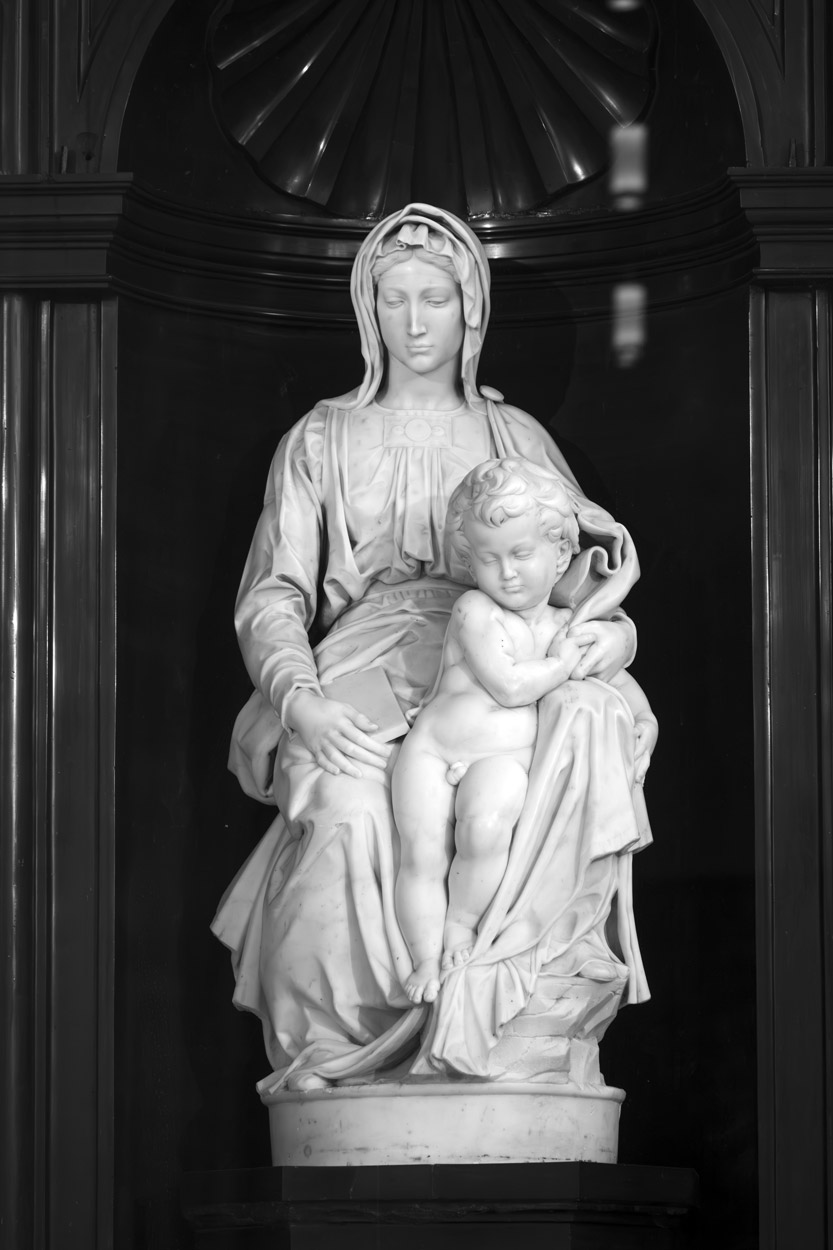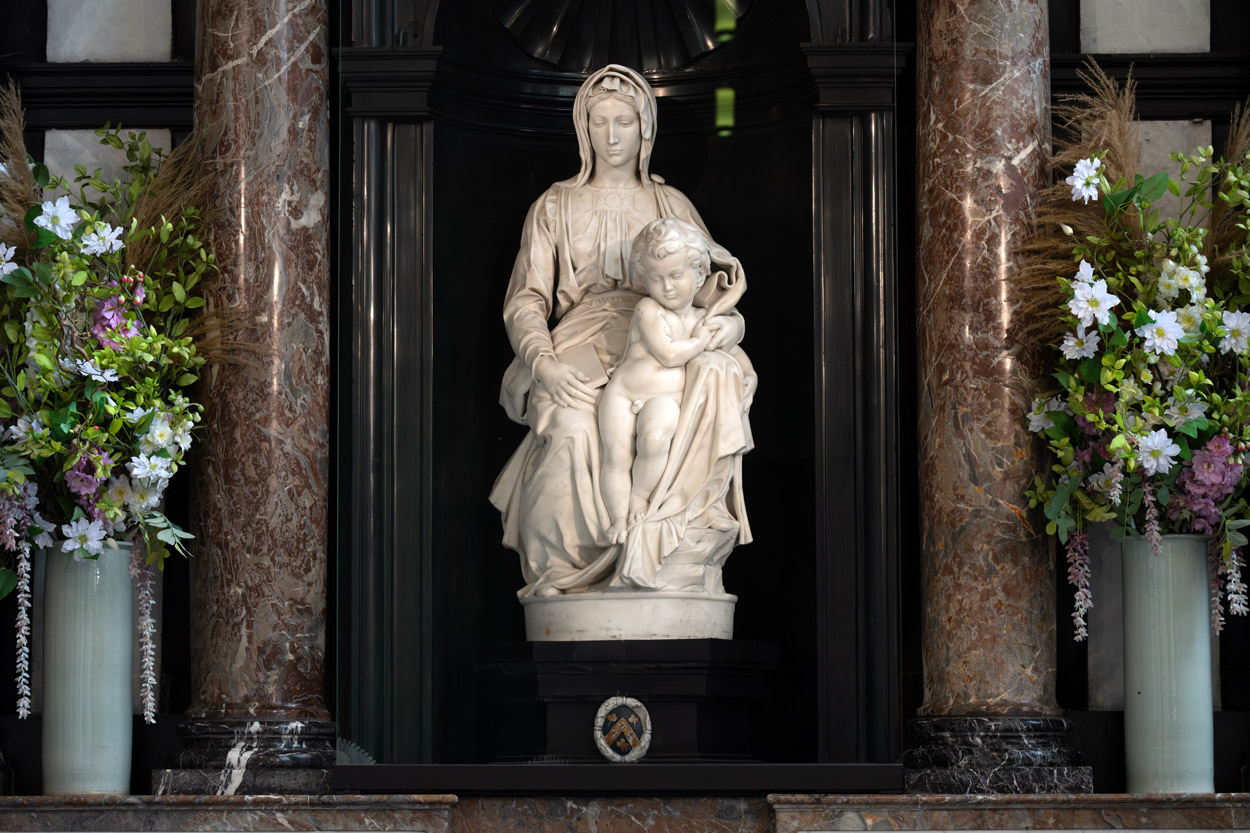
For me in any case, nothing better illustrates the historical prominence and wealth of Bruges than the magnificent Madonna and Child sculpture by Michelangelo on display in the Church of Our Lady. Wikipedia explains that the statue of Italian marble, completed in Italy in 1506, was destined for a location in Italy, but after a disagreement about money, Michelangelo sold the statue to the Mouscron brothers, two wealthy Bruges merchants. The Madonna was delivered to the buyers in Bruges and donated to its present home in 1514.
In fact Bruges played an oversized role in the revival of trade in Europe that began roughly in the 11th and 12th centuries. As European trade that had collapsed after the fall of the Western Roman Empire began to expand and flourish, Bruges for a time was northern Europe’s wealthiest leading city. In the third volume of his Civilization and Capitalism, 15th to 18th Century, French historian, Fernand Braudel, writes of Bruges:
It was all to culminate in the dazzling fortune of Bruges. By 1200, this city […] was included in the circuit of the Flemish fairs. This in itself made Bruges a more important place: she was receiving foreign merchants, her industry was thriving and her trade was reaching England and Scotland where she found the wool needed both for her looms and for re-export to the cloth-making towns of Flanders. […] And finally the arrival in Bruges of Hanseatic ships confirmed and developed her prosperity.
In 1277, the first Genoese ships put in to Bruges. The establishment of a
regular maritime link between the Mediterranean and the North Sea ushered in a decisive invasion by the southerners for the Genoese were but a foretaste of what was to come: the last of the newcomers, the Venetian galleys, arrived in 1314. […] But it was also a new departure [for Bruges] in the sense that the arrival of the sailors, ships and merchants of the Mediterranean brought in a wealth of goods, capital, and commercial and financial techniques. Rich Italian merchants came to live in the city, and brought with them consignments of some of the most precious commodities of the time: spices and pepper from the Levant which they exchanged for the industrial products of Flanders.
Thus Bruges came to be the centre of a huge trading area, covering no less than the Mediterranean, Portugal, France, England, the Rhineland, and the Hansa.
(Braudel, Fernand, tr. from the French by Siân Reynolds, Civilization and Capitalism 15th-18th Century, Volume III, The Perspective of the World, Harper & Row, New York, 1984, p99)
My interest in Europe’s medieval and early modern history, fueled by scholars like Braudel, got me to Bruges in the first place. I was curious and wanted to take a look. The fact that the old part of the city is a beautifully preserved, magnificent UNESCO World Heritage Site was unexpected and most welcome icing on the cake.
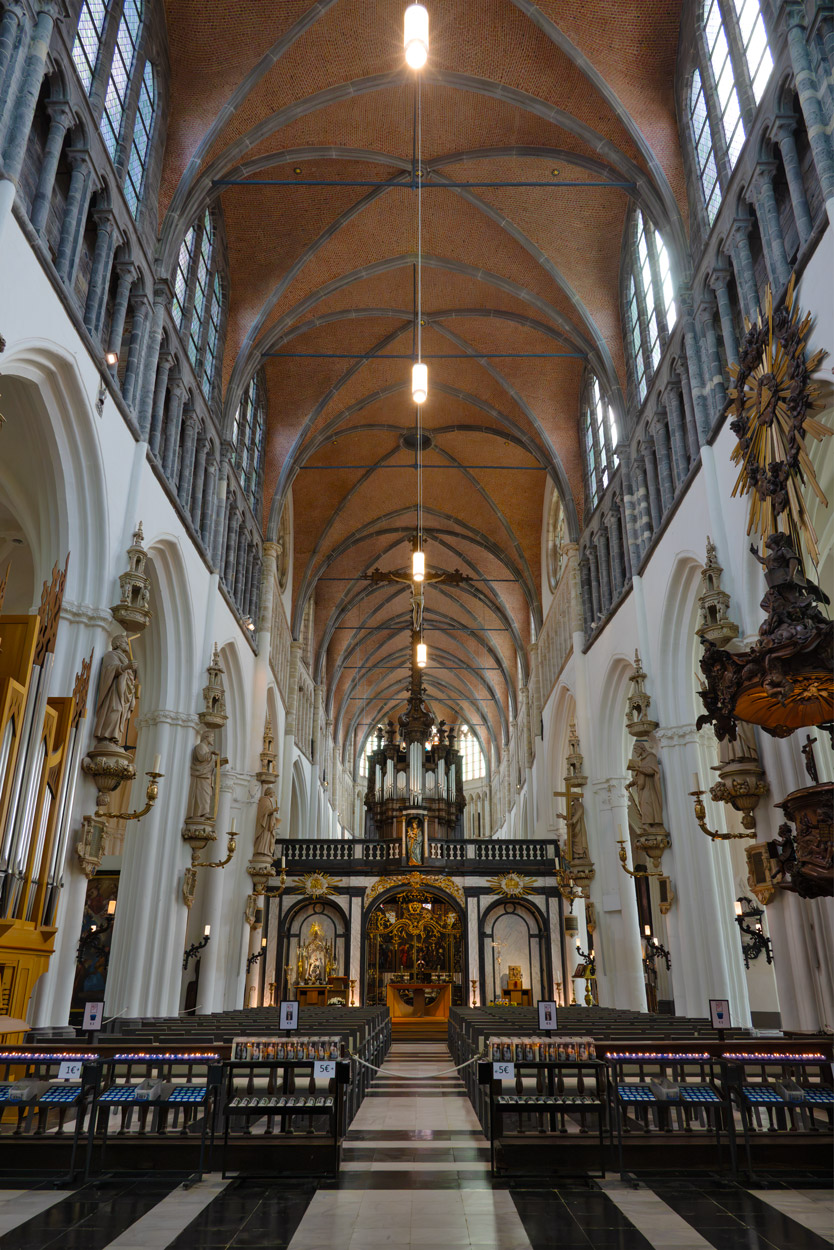
The sanctuary of the Church of Our Lady is open to the public for viewing, and like so many venerable European churches, it is impressive in and of itself. This church, however, has a part of its ground floor set aside as a museum that, if I am not mistaken, I paid €10 to enter. There was virtually nobody about when I walked around; I enjoyed an almost private viewing of the Michelangelo masterpiece. Given the crowds that often surround works by well-known artists, I was both surprised and grateful to have some quiet time in the presence of genius.