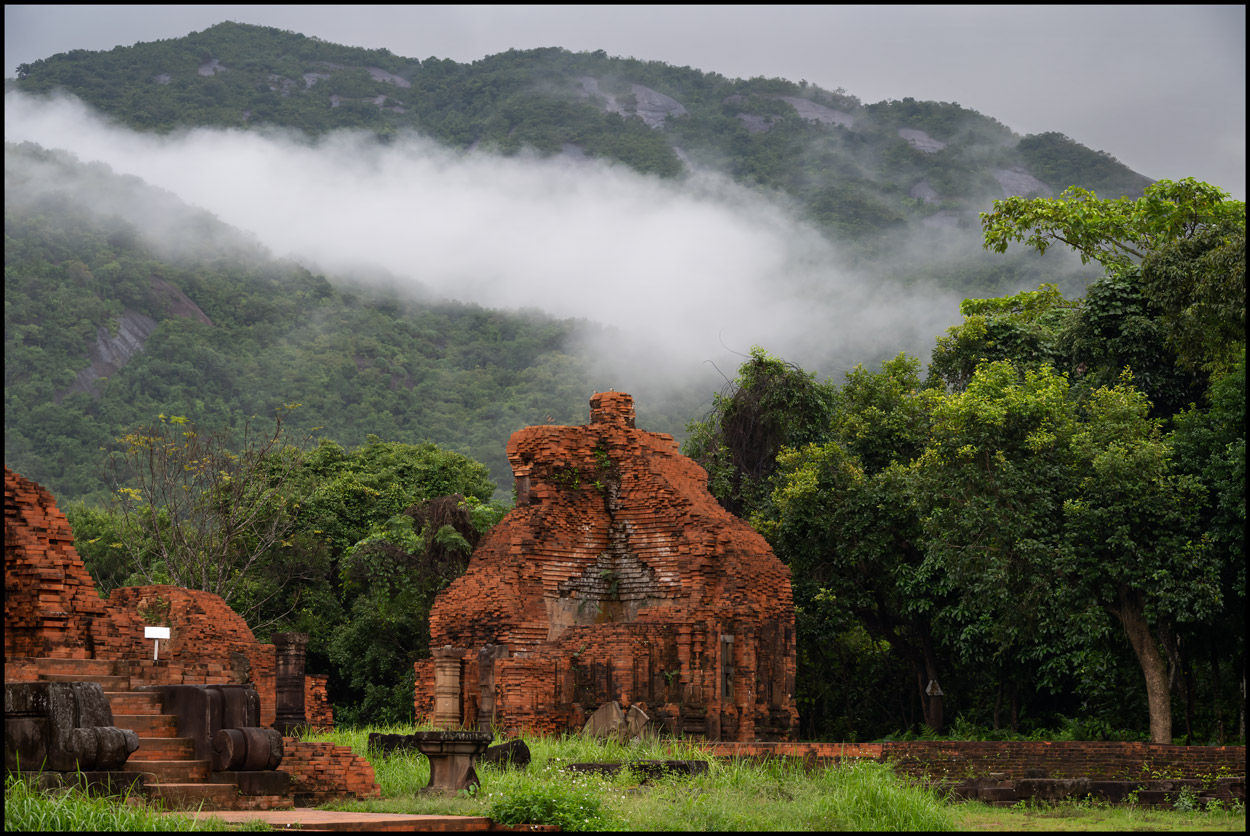
About one hour to the west of Hoi An, the UNESCO World Heritage Site, Mỹ Sơn, was an important religious center of the Cham people. The earliest Cham settlements in what is now central and southern Vietnam date back to the 3rd century CE. At some point early in their history, the Cham came into contact with Hinduism and adopted some variant of that religion. While there is debate about the extent to which the Cham in Vietnam were a unified kingdom, there is no question that Cham polities functioned throughout much of Vietnam for hundreds of years. They were traders and seafarers – Hoi An was originally a Cham port city and trading center – who developed a sophisticated civilization that presented formidable challenges to the Vietnamese living in the northern part of today’s Vietnam. For many years, there were ongoing conflicts and wars between the Cham and the Vietnamese. As the Vietnamese moved south, they eventually overran the Cham and absorbed their culture, though it was not until the 19th century that the last Cham enclaves were subdued.
Vietnamese friends have told me that the Cham people have been completely assimilated into the Vietnamese nation. While I suspect that is largely true, I have read that there is still a small, distinctly Cham ethnic minority in the country. How and to what extent Cham culture and customs have influenced the development of Vietnamese culture, I simply do not know enough about the very complex history of interaction between to two peoples to comment.
I have made two trips to My Son. The first time I went, it was a cloudy gray day. The second time I went, it was a cloudy and raining gray day. The photo above is from my second visit in November of 2024.


