
Tag: architecture
Southern Gate, Imperial City, Hue

Hue, today a small city in central Vietnam, served as the capital of the Nguyen dynasty from 1802 until the end of WWII in 1945 when the last emperor, Bao Dai, abdicated and the communist Viet Minh led by Ho Chi Minh established a government in Hanoi. As you may recall, Ho and the communists had some trouble making independence a reality. It was not until 30 years later that the North Vietnamese had managed to toss out the French and the Americans, defeat their rivals in the south of Vietnam, and establish a unified state. In any case, the Southern Gate (Ngọ Môn) pictured here was the principal ceremonial entrance to the Imperial Enclosure of the old Imperial City. Although restoration work is ongoing, the grounds and buildings inside are for the most part rather rundown, ironically giving the entire place a quietly muted grandeur. I was reminded of my first visit to the Temple of Heaven in Beijing in 1987, before all of the buildings had been restored and brightly painted, making the place look more like a movie set than the location used by Chinese emperors for imperial ceremonies. The Southern Gate has already been restored and its look and feel suggest that the Vietnamese may (thankfully) be a bit less “enthusiastic” than the Chinese in their approach to restoration.
Hanoi Opera House

The Hanoi Opera House was literally glowing in late afternoon sunlight when I came upon it. Completed by the French in 1911, the building is a reminder of Vietnam’s past as a colony of France. The Vietnamese flag flying a top the building, however, leaves no doubt about who is in charge today.
Red Flag, Yellow Star, Hanoi

The building in the background is the Imperial Citadel of Thang Long, part of the imperial structures that served as the capital of Dai Viet from the 11th to the 18th century. The building, very much in a Chinese style, is in the center of Hanoi. The boys in their bright tee shirts with a yellow star against a red background – the Vietnamese national flag – were part of a coed group of 20ish kids, I presume a university class on an outing. All of the boys were wearing the red tees. I rather liked the contrast: young people wearing the symbol of modern, socialist Vietnam against a traditional background representing the country’s imperial past.
Wat Chedi Luang, Chiang Mai

The centerpiece of Wat Chedi Luang, which according to its Wikipedia entry, means the temple of the big stuppa is this enormous stuppa in the center of the temple complex. Construction was begun by one of the Lanna kings in the 1300s, though the stuppa was not completed until the mid-fifteenth century, only to be damaged by an earthquake one hundred years later. A restoration was undertaken in the 1990s, though this has been the subject of controversy as some claim new elements in the reconstruction are in the Central Thai style, not Lanna style. Well, it’s all Thai to me. I felt quite fortunate to get a group of young monks in the foreground instead of a crowd of Chinese tourists.
The Library at Wat Phra Singh

In addition to being a very striking building, the library at Wat Phra Singh is an example of classical Lanna architecture, or so I have read. Before the modern Thai state began to take shape in the late 18th century, a Lan Na kingdom centered in Chiang Mai ruled much of the northern part of what is now Thailand. The history is complex and I certainly only know the barest outline. But Lanna as a tradition (and a marketing buzzword) is alive and well in Chiang Mai today – Lanna architecture, Lanna style, Lanna cuisine, Lanna massage, et cetera, et cetera… Be that as it may, Wat Phra Singh has one cool library building.
Wat Phra Singh, Chiang Mai
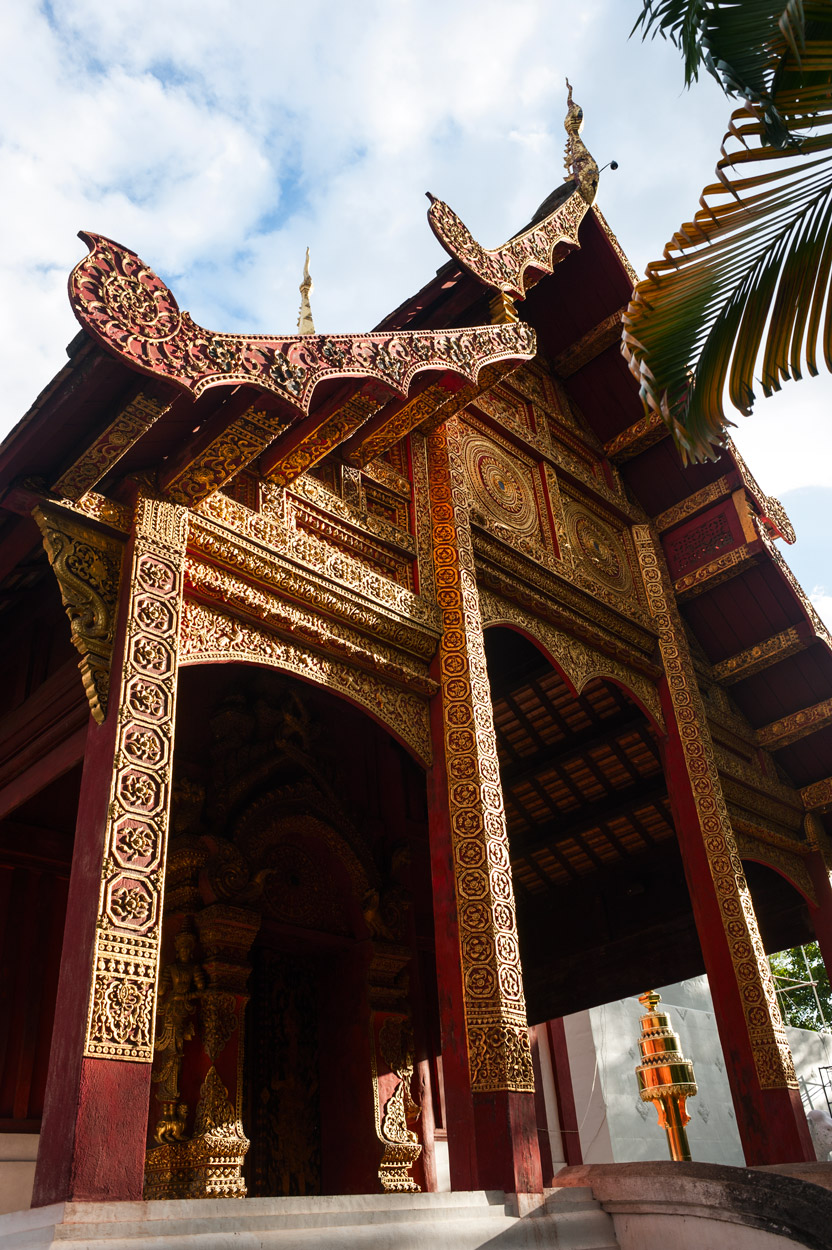
Wat Phra Singh is a large, wealthy temple complex in the center of Chiang Mai’s old city. I walked in when the apprentice monks were being led by elder monks in chants in the largest of the temples. I wanted a picture or two, but about the time I got ready to point and shoot, the chanting stopped and everybody got up and filed out of the temple. I did, however, get a number of images of the grounds, of which this is one.
Escaping the Sun, Bangkok

This photo was taken in late May when I visited the Temple of the Emerald Buddha in Bangkok. Passed right by this image the first time I looked at the pictures I shot that day, but a second look got me to reconsider. The roof moving off into the distance on the right, I think, makes the composition very dynamic. This movement really sets off the two people—the woman in her lovely rainbow colored serape—framed by the white columns as they escape the blistering hot sun for a few moments.
Wat Ban Den, Chiang Mai

Wat Chang Taem, Chiang Mai
