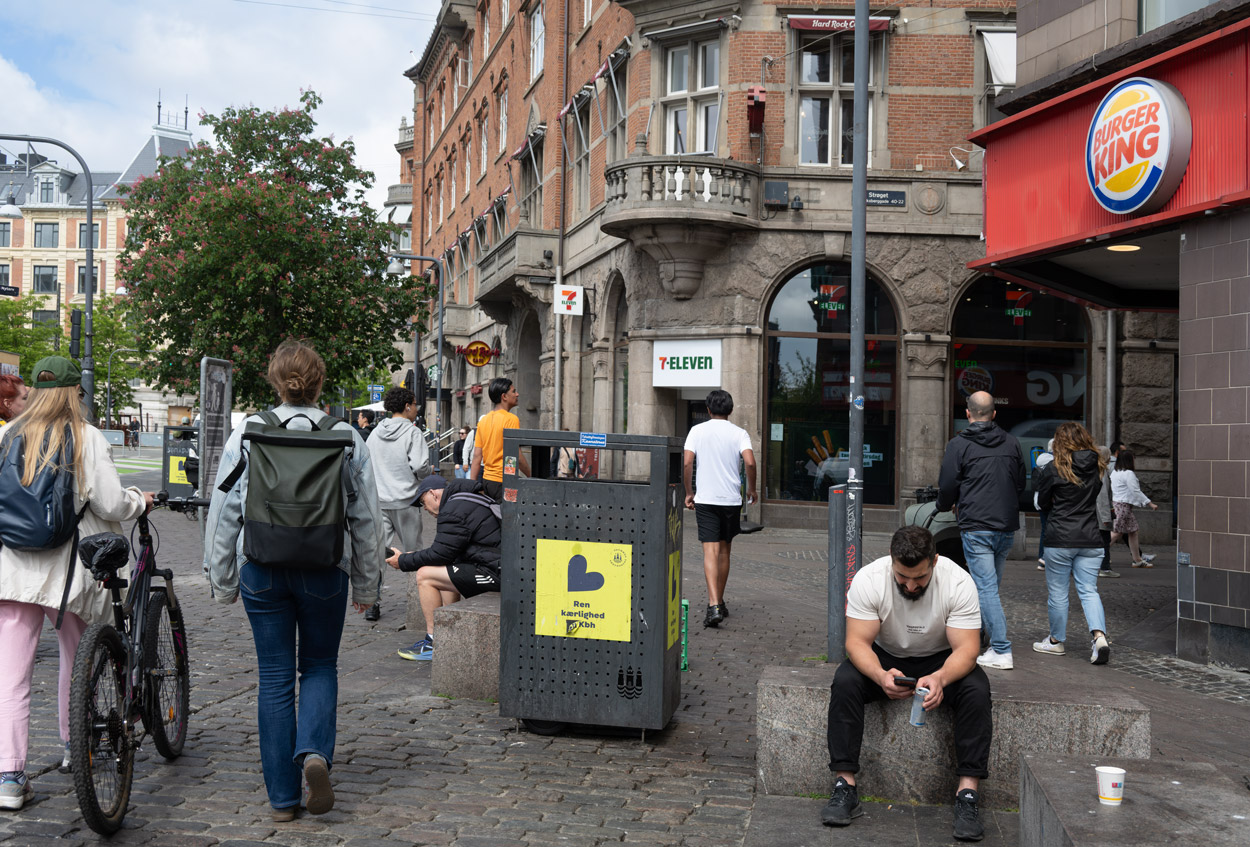
One of my meandering walks in Copenhagen brought me to this row of American businesses, purveyors of…what exactly?…foods & beverages?…culture?…soft power?…in this case, to people who are understandably rather fed up with the United States. For the record, beside me and the man who is obviously spending time at the gym, there was a KFC.
Airports in Vietnam are infested with Burger King outlets, and if I am not in the mood for a $15 bowl of pho, I can part with my $15 for what is still laughingly called a Whopper with some tasteless fries and a Coke. Or is it a Pepsi at Burger King? Does anyone care?
I don’t know what 7 Elevens are like in the US these days; in Vietnam they are standard convenience stores with small selections of all kinds of packaged foods and beverages, household goods, and personal care products along side of prepared sandwiches, pastries and cakes, and a few prepared items zapped and served hot. The European 7 Elevens I saw on this trip have a more up market appearance and are devoted almost entirely to selling prepared foods – sandwiches, salads, and other small meals prepared and delivered daily for same-day sale. Some foods can be heated. There are rows of soft drinks and juices of all kinds, and beer, wine and booze (at least in some of the shops I saw). There are fresh baked goods, as well as packaged cakes and pastries along with the usual selection of ultra-processed ingredients and too much sugar or salt or both wrapped up as cookies, chips, nachos, biscuits, and “energy” foods, ad nauseam. Much of the fare is labeled “natural.” You can also find toothpaste and toothbrush, batteries, and a very limited selection of other personal care and daily use items.
A little difficult to see in the low resolution online post is a Hard Rock Cafe sign behind the 7 Eleven. Every time I see one, I shake my head wondering how this ridiculous outfit serving up mediocre, absurdly overpriced food and drinks survives.
Even more difficult to see beyond the Hard Rock, there is a green Starbucks sign. While I am ambivalent to cynical about the other three US brands pictured here, I loathe Starbucks. In addition to overpriced bad coffee and various overpriced toxic sugar concoctions passed off as drinks, the company is run by anti-union thugs, and that alone is enough to keep me out of any Starbucks shop anywhere.
In fact, my dislike of this outfit goes back many years. I lived in Nanjing and was a frequent visitor to Shanghai when Starbucks made its first appearance in that city around the year 2000. Shanghai was exploding with growth at the time and newly affluent Chinese were developing a taste for coffee. The city had numerous recently opened coffee shops, good and not so good, some homegrown, some run by overseas entrepreneurs or coffee aficionados. Starbucks arrived on the scene with massive brand awareness, its cachet as premium, imported American coffee, and cash to burn. The company’s shops opened up with bargain basement prices that undercut small shops importing and serving genuine premium coffee. Within a matter of months, Starbucks had decimated most, if not quite all, of Shanghai’s independent coffee shops. Typical of the first casualties of Starbucks’ entry, the young Italian man who served up absolutely brilliant espresso and coffees from his tiny stall in the Shanghai American Center was gone in a matter of weeks after Starbucks opened an outlet in the Center. After wiping out most of the competition, of course, Starbucks’ prices skyrocketed, over the course of a year or two, roughly tripling from what they were when the company first arrived in Shanghai.
I know Starbucks is not the only wealthy, large company that has bullied its way into a new market by undercutting the competition with low, loss-generating prices that small businesses cannot afford to match. That does not mean I have to like Starbucks or consume its mediocre coffee, does it.
